Trade-off and risk in mitigation options for aviation

Klaus Martin Gierens
CORRESPONDING AUTHOR
Deutsches Zentrum für Luft- und Raumfahrt, Institut für Physik der Atmosphäre, Oberpfaffenhofen, Germany
Related authors
Sigrun Matthes, Klaus Gierens, Björn Beckmann, Luca Bugliaro, Simone Dietmüller, Christine Frömming, Maleen Hanst, Sina Hofer, Julian Jene, Simon Kirschler, Carmen G. Köhler, Alexander Lau, Ralph Leemüller, Aline Liedtke, Max Mendiguchia Meuser, Patrick Peter, Vanessa Santos Gabriel, Ines Köhler, Gerd Saueressig, Linda Schlemmer, Jonas Sperling, Swen Schlobach, Ralph Schultz, Kristina von Sack, and Nathalie Waltenberg
J. Env. Com. Air Transp. Sys. Discuss., https://doi.org/10.5194/jecats-2026-3, https://doi.org/10.5194/jecats-2026-3, 2026
Revised manuscript accepted for JECATS
Short summary
Short summary
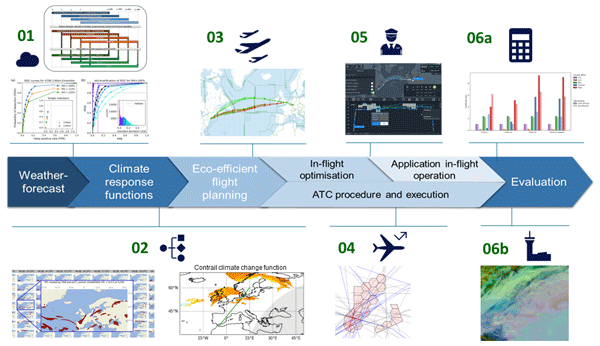
Operational strategies such as eco-efficient flight routing have potential to reduce aviation’s climate effect. A collaborative workflow integrating aviation weather forecasting, flight planning, air traffic control, and climate benefit assessment was developed and tested in D-KULT. Innovative developments demonstrate substantial progress on how to identify alternative trajectories but also highlight remaining challenges, including uncertainties in weather forecast and non-CO2 climate effects.
Sina Maria Hofer and Klaus Martin Gierens
Atmos. Chem. Phys., 25, 9235–9247, https://doi.org/10.5194/acp-25-9235-2025, https://doi.org/10.5194/acp-25-9235-2025, 2025
Short summary
Short summary
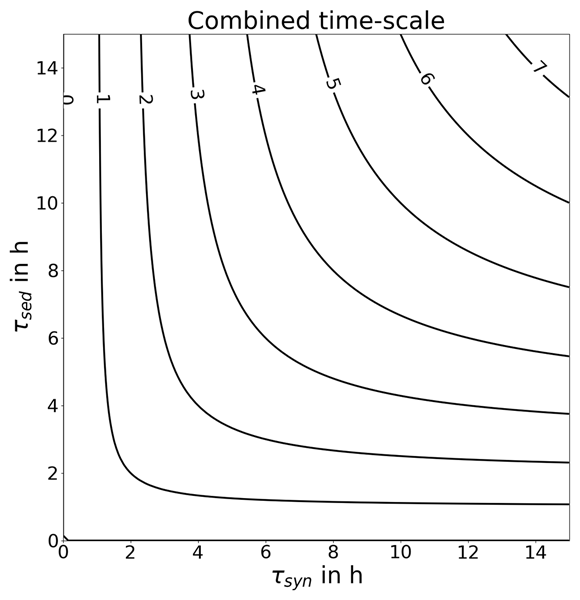
The climate effect of contrails depends on the contrail lifetime. Thus, it is important to know what constrains the lifetime. In this paper, we characterise the two most important contrail dissolution processes via their respective timescales. Both timescales are in the order of a couple of hours, depending on the synoptic situation and the size of the contrail ice crystals. The combined timescale, which combines both processes, is the harmonic mean of the two single timescales.
Sina Maria Hofer and Klaus Martin Gierens
Atmos. Chem. Phys., 25, 6843–6856, https://doi.org/10.5194/acp-25-6843-2025, https://doi.org/10.5194/acp-25-6843-2025, 2025
Short summary
Short summary
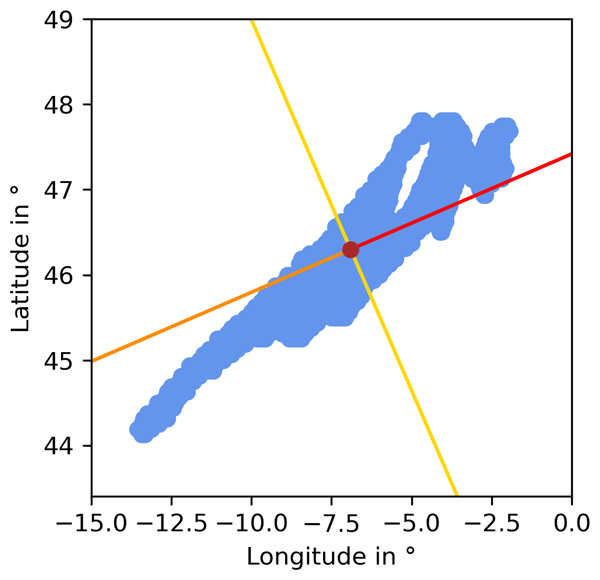
Ice supersaturation is an immaterial feature that does not generally move with the wind that carries contrails and cirrus clouds. Here we analyse the different motions and show that ice supersaturated regions (ISSRs) on average move slower than the wind, the direction of movement is usually quite similar, and the distributions of both velocities follow Weibull distributions. The almost identical direction of the movements is beneficial for contrail lifetimes.
Ziming Wang, Luca Bugliaro, Klaus Gierens, Michaela I. Hegglin, Susanne Rohs, Andreas Petzold, Stefan Kaufmann, and Christiane Voigt
Atmos. Chem. Phys., 25, 2845–2861, https://doi.org/10.5194/acp-25-2845-2025, https://doi.org/10.5194/acp-25-2845-2025, 2025
Short summary
Short summary
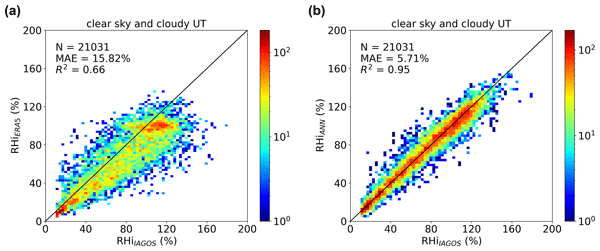
Upper-tropospheric relative humidity bias in the ERA5 weather model is corrected by 10 % by an artificial neural network using aircraft in-service humidity data and thermodynamic and dynamical variables. The improved skills of the weather model will advance cirrus research, weather forecasts, and measures for contrail reduction.
Sina Hofer, Klaus Gierens, and Susanne Rohs
Atmos. Chem. Phys., 24, 7911–7925, https://doi.org/10.5194/acp-24-7911-2024, https://doi.org/10.5194/acp-24-7911-2024, 2024
Short summary
Short summary
We try to improve the forecast of ice supersaturation (ISS) and potential persistent contrails using data on dynamical quantities in addition to temperature and relative humidity in a modern kind of regression model. Although the results are improved, they are not good enough for flight routing. The origin of the problem is the strong overlap of probability densities conditioned on cases with and without ice-supersaturated regions (ISSRs) in the important range of 70–100 %.
Dario Sperber and Klaus Gierens
Atmos. Chem. Phys., 23, 15609–15627, https://doi.org/10.5194/acp-23-15609-2023, https://doi.org/10.5194/acp-23-15609-2023, 2023
Short summary
Short summary
A significant share of aviation's climate impact is due to persistent contrails. Avoiding their creation is a step toward sustainable air transportation. For this purpose, a reliable forecast of so-called ice-supersaturated regions is needed, which then allows one to plan aircraft routes without persistent contrails. Here, we propose a method that leads to the better prediction of ice-supersaturated regions.
Klaus Gierens, Lena Wilhelm, Sina Hofer, and Susanne Rohs
Atmos. Chem. Phys., 22, 7699–7712, https://doi.org/10.5194/acp-22-7699-2022, https://doi.org/10.5194/acp-22-7699-2022, 2022
Short summary
Short summary
We are interested in the prediction of condensation trails, in particular strong ones. For this we need a good forecast of temperature and humidity in the levels where aircraft cruise. Unfortunately, the humidity forecast is quite difficult for these levels, in particular the ice supersaturation, which is needed for long-lasting contrails. We are thus seeking proxy variables that help distinguish situations where strong contrails can form, for instance the lapse rate.
Sigrun Matthes, Klaus Gierens, Björn Beckmann, Luca Bugliaro, Simone Dietmüller, Christine Frömming, Maleen Hanst, Sina Hofer, Julian Jene, Simon Kirschler, Carmen G. Köhler, Alexander Lau, Ralph Leemüller, Aline Liedtke, Max Mendiguchia Meuser, Patrick Peter, Vanessa Santos Gabriel, Ines Köhler, Gerd Saueressig, Linda Schlemmer, Jonas Sperling, Swen Schlobach, Ralph Schultz, Kristina von Sack, and Nathalie Waltenberg
J. Env. Com. Air Transp. Sys. Discuss., https://doi.org/10.5194/jecats-2026-3, https://doi.org/10.5194/jecats-2026-3, 2026
Revised manuscript accepted for JECATS
Short summary
Short summary
Operational strategies such as eco-efficient flight routing have potential to reduce aviation’s climate effect. A collaborative workflow integrating aviation weather forecasting, flight planning, air traffic control, and climate benefit assessment was developed and tested in D-KULT. Innovative developments demonstrate substantial progress on how to identify alternative trajectories but also highlight remaining challenges, including uncertainties in weather forecast and non-CO2 climate effects.
Sina Maria Hofer and Klaus Martin Gierens
Atmos. Chem. Phys., 25, 9235–9247, https://doi.org/10.5194/acp-25-9235-2025, https://doi.org/10.5194/acp-25-9235-2025, 2025
Short summary
Short summary
The climate effect of contrails depends on the contrail lifetime. Thus, it is important to know what constrains the lifetime. In this paper, we characterise the two most important contrail dissolution processes via their respective timescales. Both timescales are in the order of a couple of hours, depending on the synoptic situation and the size of the contrail ice crystals. The combined timescale, which combines both processes, is the harmonic mean of the two single timescales.
Sina Maria Hofer and Klaus Martin Gierens
Atmos. Chem. Phys., 25, 6843–6856, https://doi.org/10.5194/acp-25-6843-2025, https://doi.org/10.5194/acp-25-6843-2025, 2025
Short summary
Short summary
Ice supersaturation is an immaterial feature that does not generally move with the wind that carries contrails and cirrus clouds. Here we analyse the different motions and show that ice supersaturated regions (ISSRs) on average move slower than the wind, the direction of movement is usually quite similar, and the distributions of both velocities follow Weibull distributions. The almost identical direction of the movements is beneficial for contrail lifetimes.
Ziming Wang, Luca Bugliaro, Klaus Gierens, Michaela I. Hegglin, Susanne Rohs, Andreas Petzold, Stefan Kaufmann, and Christiane Voigt
Atmos. Chem. Phys., 25, 2845–2861, https://doi.org/10.5194/acp-25-2845-2025, https://doi.org/10.5194/acp-25-2845-2025, 2025
Short summary
Short summary
Upper-tropospheric relative humidity bias in the ERA5 weather model is corrected by 10 % by an artificial neural network using aircraft in-service humidity data and thermodynamic and dynamical variables. The improved skills of the weather model will advance cirrus research, weather forecasts, and measures for contrail reduction.
Sina Hofer, Klaus Gierens, and Susanne Rohs
Atmos. Chem. Phys., 24, 7911–7925, https://doi.org/10.5194/acp-24-7911-2024, https://doi.org/10.5194/acp-24-7911-2024, 2024
Short summary
Short summary
We try to improve the forecast of ice supersaturation (ISS) and potential persistent contrails using data on dynamical quantities in addition to temperature and relative humidity in a modern kind of regression model. Although the results are improved, they are not good enough for flight routing. The origin of the problem is the strong overlap of probability densities conditioned on cases with and without ice-supersaturated regions (ISSRs) in the important range of 70–100 %.
Dario Sperber and Klaus Gierens
Atmos. Chem. Phys., 23, 15609–15627, https://doi.org/10.5194/acp-23-15609-2023, https://doi.org/10.5194/acp-23-15609-2023, 2023
Short summary
Short summary
A significant share of aviation's climate impact is due to persistent contrails. Avoiding their creation is a step toward sustainable air transportation. For this purpose, a reliable forecast of so-called ice-supersaturated regions is needed, which then allows one to plan aircraft routes without persistent contrails. Here, we propose a method that leads to the better prediction of ice-supersaturated regions.
Klaus Gierens, Lena Wilhelm, Sina Hofer, and Susanne Rohs
Atmos. Chem. Phys., 22, 7699–7712, https://doi.org/10.5194/acp-22-7699-2022, https://doi.org/10.5194/acp-22-7699-2022, 2022
Short summary
Short summary
We are interested in the prediction of condensation trails, in particular strong ones. For this we need a good forecast of temperature and humidity in the levels where aircraft cruise. Unfortunately, the humidity forecast is quite difficult for these levels, in particular the ice supersaturation, which is needed for long-lasting contrails. We are thus seeking proxy variables that help distinguish situations where strong contrails can form, for instance the lapse rate.
Cited articles
Burkhardt, U., Bock, L., and Bier, A.: Mitigating the contrail cirrus climate impact by reducing aircraft soot number emissions, npj Climate and Atmospheric Science, 37, 1–7, https://doi.org/10.1038/s41612-018-0046-4, 2018. a
Dahlmann, K., Koch, A., Linke, F., Grewe, V., Otten, T., Seider, D., Gollnick, V., and Schumann, U.: Climate-Compatible Air Transport System – Climate Impact Mitigation Potential for Actual and Future Aircraft, Aerospace, 3, 1–25, https://doi.org/10.3390/aerospace3040038, 2016. a
Epstein, E. S.: Statistical inference and prediction in climatology: A Bayesian approach, Meteor. Mon., 20, 1–199, 1985. a
Fuglestvedt, J., Shine, K., Berntsen, T., Cook, J., Lee, D., Stenke, A., Skeie, R., Velders, G., and Waitz, I.: Transport impacts on atmosphere and climate: Metrics, Atmos. Environ., 44, 4648–4677, https://doi.org/10.1016/j.atmosenv.2009.04.044, 2010. a, b, c, d
Fuglestvedt, J. S., Berntsen, T. K., Godal, O., Sausen, R., Shine, K. P., and Skodvin, T.: Metrics of climate change: assessing radiative forcing and emission indices, Clim. Change, 58, 267–331, 2003. a
Gettelman, A., Chen, C.-C., and Bardeen, C. G.: The climate impact of COVID-19-induced contrail changes, Atmos. Chem. Phys., 21, 9405–9416, https://doi.org/10.5194/acp-21-9405-2021, 2021. a, b
Grewe, V., Bock, L., Burkhardt, U., Dahlmann, K., Gierens, K. M., Hüttenhofer, L., Unterstrasser, S., Rao, A., Bhat, A., Yin, F., Reichel, T., Paschereit, O., and Levy, Y.: Assessing the climate impact of the AHEAD multi-fuel blended wing body, Meteorol. Z., 26, 711–725, https://doi.org/10.1127/metz/2016/0758, 2017a. a
Grewe, V., Dahlmann, K., Flink, J., Frömming, C., Ghosh, R., Gierens, K., Heller, R., Hendricks, J., Jöckel, P., Kaufmann, S., Kölker, K., Linke, F., Luchkova, T., Lührs, B., van Manen, J., Matthes, S., Minikin, A., Niklaß, M., Plohr, M., Righi, M., Rosanka, S., Schmitt, A., Schumann, U., Terekhov, I., Unterstrasser, S., Vázquez-Navarro, M., Voigt, C., Wicke, K., Yamashita, H., Zahn, A., and Ziereis, H.: Mitigating the Climate Impact from Aviation: Achievements and Results of the DLR WeCare Project, Aerospace, 4, 34, https://doi.org/10.3390/aerospace4030034, 2017b. a
Haglind, F.: Potential of lowering the contrail formation of aircraft exhausts by engine re–design, Aerospace Sci. Technol., 12, 490–497, 2008. a
Joos, F., Roth, R., Fuglestvedt, J. S., Peters, G. P., Enting, I. G., von Bloh, W., Brovkin, V., Burke, E. J., Eby, M., Edwards, N. R., Friedrich, T., Frölicher, T. L., Halloran, P. R., Holden, P. B., Jones, C., Kleinen, T., Mackenzie, F. T., Matsumoto, K., Meinshausen, M., Plattner, G.-K., Reisinger, A., Segschneider, J., Shaffer, G., Steinacher, M., Strassmann, K., Tanaka, K., Timmermann, A., and Weaver, A. J.: Carbon dioxide and climate impulse response functions for the computation of greenhouse gas metrics: a multi-model analysis, Atmos. Chem. Phys., 13, 2793–2825, https://doi.org/10.5194/acp-13-2793-2013, 2013. a
Lee, D., Pitari, G., Grewe, V., Gierens, K., Penner, J., Petzold, A., Prather, M., Schumann, U., Bais, A., Berntsen, T., Iachetti, D., Lim, L., and Sausen, R.: Transport impacts on atmosphere and climate: Aviation, Atmos. Environ., 44, 4678–4734, 2012. a
Lee, D., Fahey, D., Skowron, A., Allen, M., Burkhardt, U., Chen, Q., Doherty, S., Freeman, S., Forster, P., Fuglestvedt, J., Gettelman, A., De León, R., Lim, L., Lund, M., Millar, R., Owen, B., Penner, J., Pitari, G., Prather, M., Sausen, R., and Wilcox, L.: The contribution of global aviation to anthropogenic climate forcing for 2000 to 2018, Atmos. Environ., 244, 117834, https://doi.org/10.1016/j.atmosenv.2020.117834, 2021. a, b, c, d, e, f, g, h, i, j
Lee, D. S., Allen, M. R., Cumpsty, N., Owen, B., Shine, K. P., and Skowron, A.: Uncertainties in mitigating aviation non-CO 2 emissions for climate and air quality using hydrocarbon fuels, Environ. Sci.: Atmospheres, 3, 1693–1740, 2023. a
Mannstein, H., Spichtinger, P., and Gierens, K.: A note on how to avoid contrails, Transport. Res. D-Tr. E., 10, 421–426, 2005. a
Märkl, R. S., Voigt, C., Sauer, D., Dischl, R. K., Kaufmann, S., Harlaß, T., Hahn, V., Roiger, A., Weiß-Rehm, C., Burkhardt, U., Schumann, U., Marsing, A., Scheibe, M., Dörnbrack, A., Renard, C., Gauthier, M., Swann, P., Madden, P., Luff, D., Sallinen, R., Schripp, T., and Le Clercq, P.: Powering aircraft with 100 % sustainable aviation fuel reduces ice crystals in contrails, Atmos. Chem. Phys., 24, 3813–3837, https://doi.org/10.5194/acp-24-3813-2024, 2024. a
Matthes, S., Lim, L., Burkhardt, U., Dahlmann, K., Dietmüller, S., Grewe, V., Haslerud, A. S., Hendricks, J., Owen, B., Pitari, G., Righi, M., and Skowron, A.: Mitigation of Non-CO2 Aviation's Climate Impact by Changing Cruise Altitudes, Aerospace, 8, 1–20, https://doi.org/10.3390/aerospace8020036, 2021. a
Noppel, F. and Singh, R.: An overview on contrail and cirrus cloud avoidance technology, J. Aircraft, 44, 1721–1726, 2007. a
Ponater, M., Pechtl, S., Sausen, R., Schumann, U., and Hüttig, G.: Potential of the cryoplane technology to reduce aircraft climate impact: A state-of-the-art assessment, Atmos. Environ., 40, 6928–6944, https://doi.org/10.1016/j.atmosenv.2006.06.036, 2006. a
Pouzolz, R., Schmitz, O., and Klingels, H.: Evaluation of the climate impact reduction potential of the water-enhanced turbofan (WET) concept, Aerospace, 8, 59, https://doi.org/10.3390/aerospace8030059, 2021. a
Quaas, J., Gryspeerdt, E., Vautard, R., and Boucher, O.: Climate impact of aircraft-induced cirrus assessed from satellite observations before and during COVID-19, Environ. Res. Lett., 16, 064051, https://doi.org/10.1088/1748-9326/abf686, 2021. a
Sausen, R., Nodorp, D., and Land, C.: Towards an optimal flight routing with respect to minimal environmental impact, in: Impact of Emissions from Aircraft and Spacecraft upon the Atmosphere, edited by: Schumann, U. and Wurzel, D., no. 94-06 in DLR-Mitteilung, 473–478, Köln, Germany, 1994. a
Sausen, R., Hofer, S. M., Gierens, K. M., Bugliaro Goggia, L., Ehrmanntraut, R., Sitova, I., Walczak, K., Burridge-Diesing, A., Bowman, M., and Miller, N.: Can we successfully avoid persistent contrails by small altitude adjustments of flights in the real world?, Meteorol. Z., 33, 83–98, https://doi.org/10.1127/metz/2023/1157, 2024. a
Shine, K.: The global warming potential – the need for an interdisciplinary retrial – an editorial comment, Clim. Change, 96, 467–472, https://doi.org/10.1007/s10584-009-9647-6, 2009. a
Skowron, A., Lee, D. S., Leon, R. R. D., Lim, L. L., and Owen, B.: Greater fuel efficiency is potentially preferable to reducing NOx emissions for aviation's climate impacts, Nat. Commun., 12, 564, https://doi.org/10.1038/s41467-020-20771-3, 2021. a
Teoh, R., Schumann, U., Majumdar, A., and Stettler, M.: Mitigating the climate forcing of aircraft contrails by small-scale diversions and technology adoption, Environ. Sci. Technol., 54, 2941–2950, https://doi.org/10.1021/acs.est.9b05608, 2020. a
Wilhelm, L., Gierens, K., and Rohs, S.: Weather variability induced uncertainty of contrail radiative forcing, Aerospace, 8, https://doi.org/10.3390/aerospace8110332, 2021. a, b
Williams, V., Noland, R., and Toumi, R.: Reducing the climate change impacts of aviation by restricting cruise altitudes, Transport. Res. D-Tr. E., 7, 451–464, 2002. a
Williams, V., Noland, R., and Toumi, R.: Air transport cruise altitude restrictions to minimize contrail formation, Clim. Policy, 3, 207–219, 2003. a
Short summary
Lessening of non-CO2 aviation impacts on climate is often accompanied by an increase of fuel consumption and emissions. Planning mitigation actions requires balancing the desired climate benefit against inevitable simultaneous climate damage. Due to uncertainty, statistical methods are needed to estimate the failure risk of concrete mitigation measures. This paper presents the required mathematics.
Lessening of non-CO2 aviation impacts on climate is often accompanied by an increase of fuel...