Research article
| 
19 Nov 2026
Research article |
| 19 Nov 2026
| 19 Nov 2026
Efficacy of scalable airline-led contrail avoidance

Google Research, 1600 Amphitheatre Pkwy, Mountain View, CA, USA
Thomas Dean
Contrails.org, 4110 Carillon Point, Kirkland, WA, USA
Tristan Abbott
Contrails.org, 4110 Carillon Point, Kirkland, WA, USA
Jill Blickstein
American Airlines, 1 Skyview Drive, Fort Worth, TX, USA
Alejandra Martín Frías
Flightkeys, Herrengasse 2–4, 1010 Vienna, Austria
Mark Galyen
American Airlines, 1 Skyview Drive, Fort Worth, TX, USA
Rebecca Grenham
American Airlines, 1 Skyview Drive, Fort Worth, TX, USA
Paul Hodgson
Contrails.org, 4110 Carillon Point, Kirkland, WA, USA
Kevin McCloskey
Google Research, 1600 Amphitheatre Pkwy, Mountain View, CA, USA
Alan Pechman
American Airlines, 1 Skyview Drive, Fort Worth, TX, USA
Tyler Robarge
Contrails.org, 4110 Carillon Point, Kirkland, WA, USA
Dinesh Sanekommu
Google Research, 1600 Amphitheatre Pkwy, Mountain View, CA, USA
Aaron Sarna
Google Research, 1600 Amphitheatre Pkwy, Mountain View, CA, USA
Aaron Sonabend-W
Google Research, 1600 Amphitheatre Pkwy, Mountain View, CA, USA
Marc Stettler
Contrails.org, 4110 Carillon Point, Kirkland, WA, USA
Imperial College London, Exhibition Road, South Kensington, London, UK
Raimund Zopp
Flightkeys, Herrengasse 2–4, 1010 Vienna, Austria
Scott Geraedts
Google Research, 1600 Amphitheatre Pkwy, Mountain View, CA, USA
Related authors
No articles found.
Dominik P. Nakoneczny, Jonathan P. Itcovitz, Denis Vida, Luc Busquin, Tristan H. Abbott, and Marc E. J. Stettler
EGUsphere, https://doi.org/10.5194/egusphere-2026-5251, https://doi.org/10.5194/egusphere-2026-5251, 2026
Short summary
Short summary
Contrails are ice clouds left by aircraft that persist in cold, humid air, adding a large fraction to aviation's climate impact. Testing and improving forecasts requires labelled datasets of contrail observations. We used ground camera images of contrails and matched them to their originating aircraft. Our "flight-first" method searches for contrails based on where they're predicted to be, making detections faster and more reliable. This scalable approach could help track contrails worldwide.
Sebastian David Eastham, Hamid Reza Abbasi, Marc E. J. Stettler, Tristan Abbott, and Zebediah Engberg
EGUsphere, https://doi.org/10.5194/egusphere-2026-4489, https://doi.org/10.5194/egusphere-2026-4489, 2026
This preprint is open for discussion and under review for Geoscientific Model Development (GMD).
Short summary
Short summary
Aircraft condensation trails (contrails) have been estimated as being responsible for up to half of aviation's overall climate impacts, but this is subject to high uncertainty and few contrail models are fast enough to support rapid exploration of the parameter space. We present CLAMP, a new contrail model designed to simulate a 12-hour contrail in less than a minute while providing results similar to higher-fidelity approaches.
Scott Geraedts, Aaron Sarna, Susanne Rohs, Roger Teoh, and Kevin McCloskey
J. Env. Com. Air Transp. Sys., 1, 2, https://doi.org/10.5194/jecats-1-2-2026, https://doi.org/10.5194/jecats-1-2-2026, 2026
Short summary
Short summary
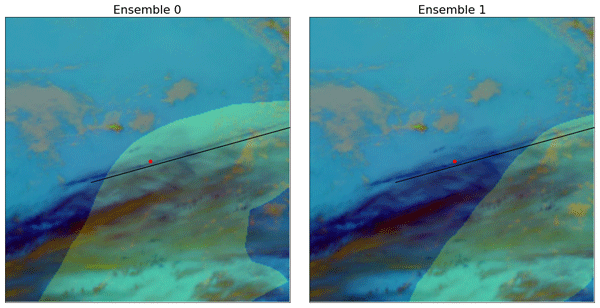
It can be difficult to know if a given aircraft made a contrail. Existing methods that can be applied to any aircraft either use numerical weather data or satellite observations. In this work we create a new method by combining weather data and observations together. By comparison to in-situ measurements we show that the new method is superior to previous methods.
Aaron Sonabend-W, Scott Geraedts, Nita Goyal, Joe Yue-Hei Ng, Christopher Van Arsdale, and Kevin McCloskey
Atmos. Meas. Tech., 19, 1951–1972, https://doi.org/10.5194/amt-19-1951-2026, https://doi.org/10.5194/amt-19-1951-2026, 2026
Short summary
Short summary
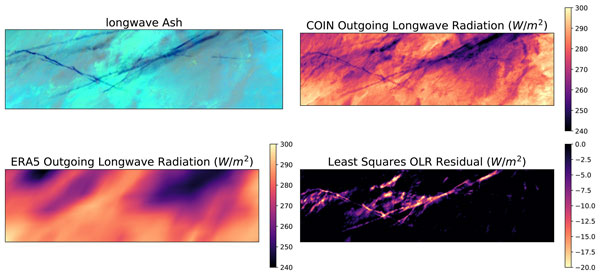
Airplane condensation trails trap heat, but their full warming effect is hard to measure because they blend into natural clouds. Using satellite observations, weather data, flight paths, and a causal inference framework, we isolated this effect without simulations or contrail masks. We found contrails trap 46.9 gigajoules of heat per kilometer flown over the Americas. This provides a crucially missing observation-based estimate of a major portion of aviation’s environmental impact.
Joel Ponsonby, Roger Teoh, Bernd Kärcher, and Marc E. J. Stettler
Atmos. Chem. Phys., 25, 18617–18637, https://doi.org/10.5194/acp-25-18617-2025, https://doi.org/10.5194/acp-25-18617-2025, 2025
Short summary
Short summary
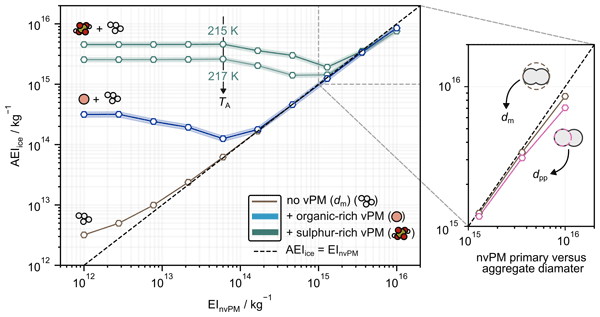
Aerosol emissions from aircraft engines contribute to the formation of contrails, which have a climate impact comparable to that of aviation’s CO2 emissions. We show that emissions of volatile particulate matter – from fuel sulphur, unburned fuel, and lubrication oil – can increase the number of ice particles formed within a contrail and therefore have an important role in the climate impacts of aviation. This has implications for emission regulation and climate mitigation strategies.
Oliver G. A. Driver, Marc E. J. Stettler, and Edward Gryspeerdt
Atmos. Chem. Phys., 25, 16411–16433, https://doi.org/10.5194/acp-25-16411-2025, https://doi.org/10.5194/acp-25-16411-2025, 2025
Short summary
Short summary
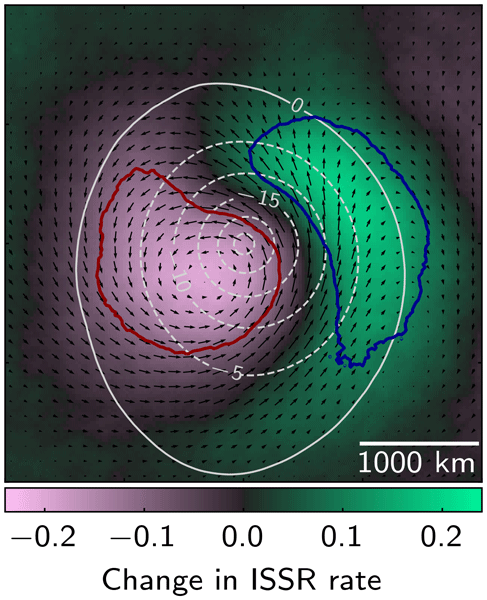
Contrails are ice clouds caused by planes. They have a warming effect, so are important to model. In humid (ice supersaturated) regions, ice crystals are stable so can persist. However, weather model data doesn't represent ice supersaturated regions well enough. We demonstrate that ice supersaturation modelling is structured by North Atlantic storm systems. Averaging many systems, we link the bias to underling processes being modelled, and gain insight into how the existing data could be used.
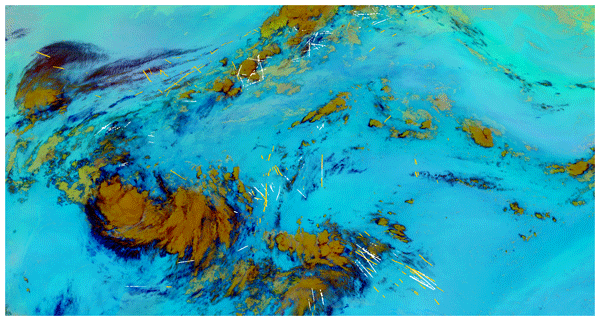
Aaron Sarna, Vincent Meijer, Rémi Chevallier, Allie Duncan, Kyle McConnaughay, Scott Geraedts, and Kevin McCloskey
Atmos. Meas. Tech., 18, 3495–3532, https://doi.org/10.5194/amt-18-3495-2025, https://doi.org/10.5194/amt-18-3495-2025, 2025
Short summary
Short summary
Contrails, the clouds formed by aircraft, are have a substantial climate impact. Determining which flight formed each contrail is a critical step to decreasing this impact. We introduce a dataset of synthetic contrail observations with known flight attributions that can be used to develop and assess geostationary-satellite-based contrail-to-flight attribution systems. We additionally introduce a new attribution algorithm and show that it outperforms previous methods.
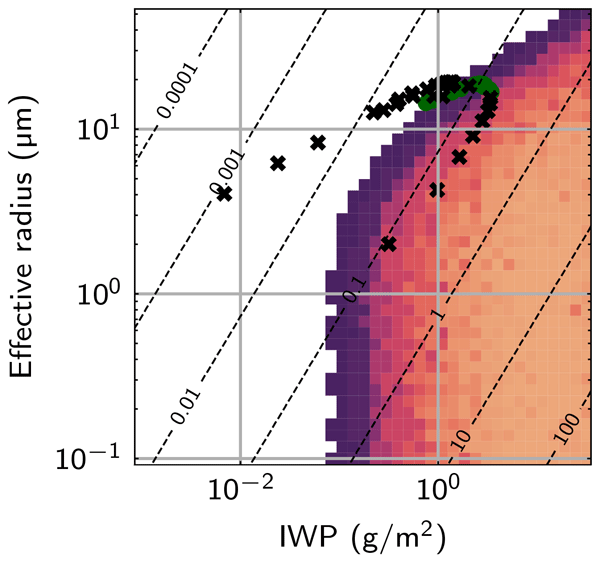
Oliver G. A. Driver, Marc E. J. Stettler, and Edward Gryspeerdt
Atmos. Meas. Tech., 18, 1115–1134, https://doi.org/10.5194/amt-18-1115-2025, https://doi.org/10.5194/amt-18-1115-2025, 2025
Short summary
Short summary
Contrails (clouds caused by planes) play a large role in the climate warming caused by aviation. Satellites are a good tool to validate modelled impact estimates. Many contrails are either too narrow or too disperse to detect. This work shows that only around half of contrails are observable but that the most climatically important are easier to detect. It supports the use of satellites for contrail observation but highlights the need for observability considerations for specific applications.
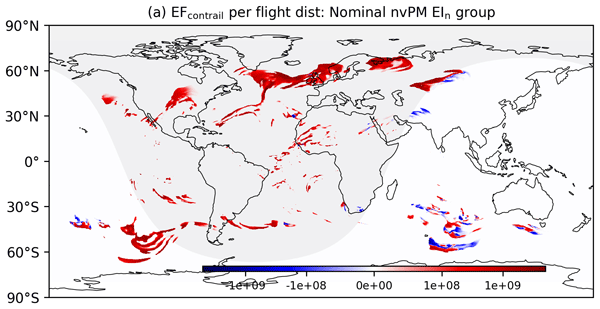
Zebediah Engberg, Roger Teoh, Tristan Abbott, Thomas Dean, Marc E. J. Stettler, and Marc L. Shapiro
Geosci. Model Dev., 18, 253–286, https://doi.org/10.5194/gmd-18-253-2025, https://doi.org/10.5194/gmd-18-253-2025, 2025
Short summary
Short summary
Contrails forming in some atmospheric conditions may persist and become strongly warming cirrus, while in other conditions may be neutral or cooling. We develop a contrail forecast model to predict contrail climate forcing for any arbitrary point in space and time and explore integration into flight planning and air traffic management. This approach enables contrail interventions to target high-probability high-climate-impact regions and reduce unintended consequences of contrail management.
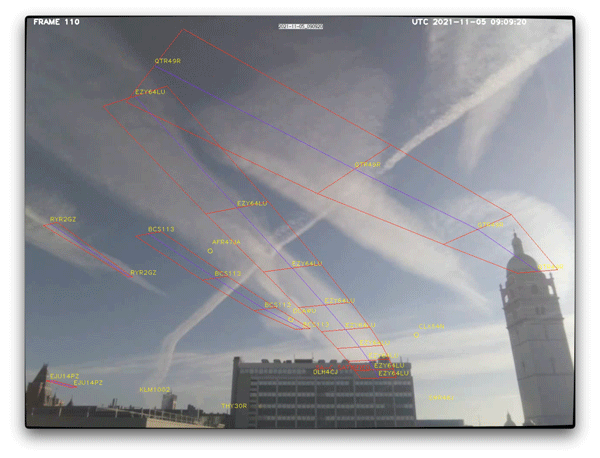
Jade Low, Roger Teoh, Joel Ponsonby, Edward Gryspeerdt, Marc Shapiro, and Marc E. J. Stettler
Atmos. Meas. Tech., 18, 37–56, https://doi.org/10.5194/amt-18-37-2025, https://doi.org/10.5194/amt-18-37-2025, 2025
Short summary
Short summary
The radiative forcing due to contrails is of the same order of magnitude as aviation CO2 emissions but has a higher uncertainty. Observations are vital to improve our understanding of the contrail lifecycle, improve models, and measure the effect of mitigation action. Here, we use ground-based cameras combined with flight telemetry to track visible contrails and measure their lifetime and width. We evaluate model predictions and demonstrate the capability of this approach.

Audran Borella, Olivier Boucher, Keith P. Shine, Marc Stettler, Katsumasa Tanaka, Roger Teoh, and Nicolas Bellouin
Atmos. Chem. Phys., 24, 9401–9417, https://doi.org/10.5194/acp-24-9401-2024, https://doi.org/10.5194/acp-24-9401-2024, 2024
Short summary
Short summary
This work studies how to compare the climate impact of the CO2 emitted and contrails formed by a flight. This is applied to contrail avoidance strategies that would decrease climate impact of flights by changing the trajectory of aircraft to avoid persistent contrail formation, at the risk of increasing CO2 emissions. We find that different comparison methods lead to different quantification of the total climate impact of a flight but lead to similar decisions of whether to reroute an aircraft.
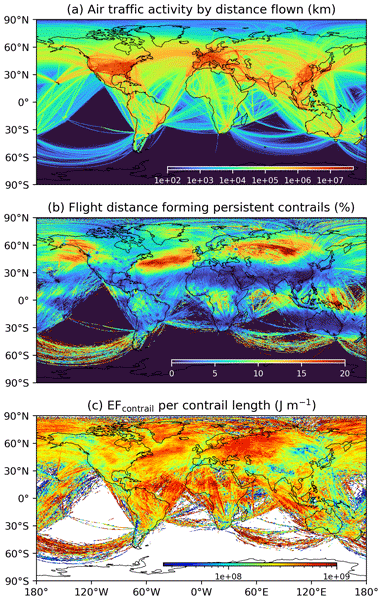
Roger Teoh, Zebediah Engberg, Ulrich Schumann, Christiane Voigt, Marc Shapiro, Susanne Rohs, and Marc E. J. Stettler
Atmos. Chem. Phys., 24, 6071–6093, https://doi.org/10.5194/acp-24-6071-2024, https://doi.org/10.5194/acp-24-6071-2024, 2024
Short summary
Short summary
The radiative forcing (RF) due to aviation contrails is comparable to that caused by CO2. We estimate that global contrail net RF in 2019 was 62.1 mW m−2. This is ~1/2 the previous best estimate for 2018. Contrail RF varies regionally due to differences in conditions required for persistent contrails. COVID-19 reduced contrail RF by 54% in 2020 relative to 2019. Globally, 2 % of all flights account for 80 % of the annual contrail energy forcing, suggesting a opportunity to mitigate contrail RF.
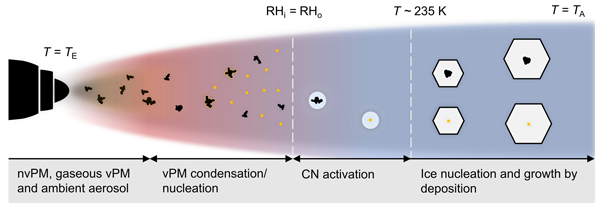
Joel Ponsonby, Leon King, Benjamin J. Murray, and Marc E. J. Stettler
Atmos. Chem. Phys., 24, 2045–2058, https://doi.org/10.5194/acp-24-2045-2024, https://doi.org/10.5194/acp-24-2045-2024, 2024
Short summary
Short summary
Aerosol emissions from aircraft engines contribute to the formation of contrails, which have a climate impact as important as that of aviation’s CO2 emissions. For the first time, we experimentally investigate the freezing behaviour of water droplets formed on jet lubrication oil aerosol. We show that they can activate to form water droplets and discuss their potential impact on contrail formation. Our study has implications for contrails produced by future aircraft engine and fuel technologies.
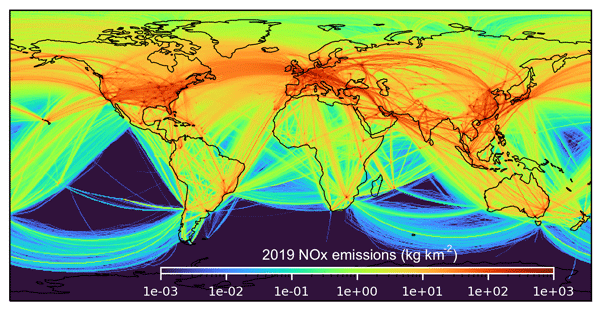
Roger Teoh, Zebediah Engberg, Marc Shapiro, Lynnette Dray, and Marc E. J. Stettler
Atmos. Chem. Phys., 24, 725–744, https://doi.org/10.5194/acp-24-725-2024, https://doi.org/10.5194/acp-24-725-2024, 2024
Short summary
Short summary
Emissions from aircraft contribute to climate change and degrade air quality. We describe an up-to-date 4D emissions inventory of global aviation from 2019 to 2021 based on actual flown trajectories. In 2019, 40.2 million flights collectively travelled 61 billion kilometres using 283 Tg of fuel. Long-haul flights were responsible for 43 % of CO2. The emissions inventory is made available for use in future studies to evaluate the negative externalities arising from global aviation.
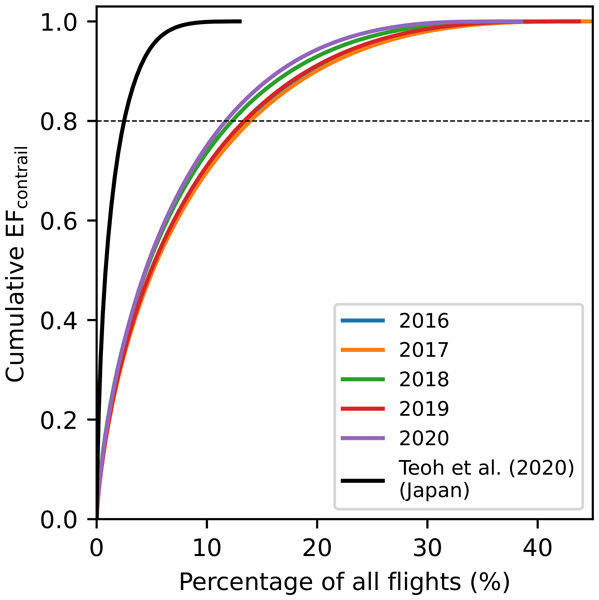
Roger Teoh, Ulrich Schumann, Edward Gryspeerdt, Marc Shapiro, Jarlath Molloy, George Koudis, Christiane Voigt, and Marc E. J. Stettler
Atmos. Chem. Phys., 22, 10919–10935, https://doi.org/10.5194/acp-22-10919-2022, https://doi.org/10.5194/acp-22-10919-2022, 2022
Short summary
Short summary
Aircraft condensation trails (contrails) contribute to over half of the climate forcing attributable to aviation. This study uses historical air traffic and weather data to simulate contrails in the North Atlantic over 5 years, from 2016 to 2021. We found large intra- and inter-year variability in contrail radiative forcing and observed a 66 % reduction due to COVID-19. Most warming contrails predominantly result from night-time flights in winter.
Cited articles
Agarwal, A., Meijer, V. R., Eastham, S. D., Speth, R. L., and Barrett, S. R.: Reanalysis-driven simulations may overestimate persistent contrail formation by 100 %–250 %, Environ. Res. Lett., 17, 014045, https://doi.org/10.1088/1748-9326/ac38d9, 2022. a, b, c
Akhtar Martínez, C., Eastham, S. D., and Jarrett, J. P.: Zero-dimensional contrail models could underpredict lifetime optical depth, Atmos. Chem. Phys., 25, 12875–12891, https://doi.org/10.5194/acp-25-12875-2025, 2025. a
Bogacki, P. and Shampine, L. F.: A 3 (2) pair of Runge-Kutta formulas, Appl. Math. Lett., 2, 321–325, https://doi.org/10.1016/0893-9659(89)90079-7, 1989. a
Borella, A., Boucher, O., Shine, K. P., Stettler, M., Tanaka, K., Teoh, R., and Bellouin, N.: The importance of an informed choice of CO2-equivalence metrics for contrail avoidance, Atmos. Chem. Phys., 24, 9401–9417, https://doi.org/10.5194/acp-24-9401-2024, 2024. a
Burkhardt, U., Bock, L., and Bier, A.: Mitigating the contrail cirrus climate impact by reducing aircraft soot number emissions, npj Climate and Atmospheric Science, 1, 37, https://doi.org/10.1038/s41612-018-0046-4, 2018. a
Dean, T. R., Abbott, T. H., Engberg, Z., Masson, N., Teoh, R., Itcovitz, J. P., Stettler, M. E., and Shapiro, M. L.: Impact of forecast stability on navigational contrail avoidance, Environmental Research: Infrastructure and Sustainability, 5, 045 008, https://doi.org/10.1088/2634-4505/ae1da5, 2025. a, b, c, d, e
Driver, O. G. A., Stettler, M. E. J., and Gryspeerdt, E.: Factors limiting contrail detection in satellite imagery, Atmos. Meas. Tech., 18, 1115–1134, https://doi.org/10.5194/amt-18-1115-2025, 2025. a, b
Euchenhofer, M. V., Prashanth, P., Parke, S. A., Eastham, S. D., and Waitz, I. A.: Contrail observation limitations using geostationary satellites, Geophys. Res. Lett., 52, e2025GL118386, https://doi.org/10.1029/2025GL118386, 2025. a
Frias, A. M., Shapiro, M. L., Engberg, Z., Zopp, R., Soler, M., and Stettler, M. E. J.: Feasibility of contrail avoidance in a commercial flight planning system: an operational analysis, Environmental Research: Infrastructure and Sustainability, 4, 015013, https://doi.org/10.1088/2634-4505/ad310c, 2024. a, b, c, d, e, f, g
Frias, A. M., Soler, M., Dean, T., and Zopp, R.: Evaluating Soft and Hard Contrail Avoidance Strategies in Commercial Flight Planning: Implementation and Effectiveness Analysis, SSRN 6341458, https://doi.org/10.1016/j.jairtraman.2026.103089, 2025. a, b
Geraedts, S., Sarna, A., Rohs, S., Teoh, R., and McCloskey, K.: Improving reanalysis weather for contrail validation by incorporating satellite observations, J. Env. Com. Air Transp. Sys., 1, 2, https://doi.org/10.5194/jecats-1-2-2026, 2026. a
Gierens, K., Matthes, S., and Rohs, S.: How well can persistent contrails be predicted?, Aerospace, 7, 169, https://doi.org/10.3390/aerospace7120169, 2020. a, b, c, d
Goodman, S. J., Schmit, T. J., Daniels, J., and Redmon, R. J.: The GOES-R series: a new generation of geostationary environmental satellites, Elsevier, https://doi.org/10.1016/C2015-0-06249-9, 2019. a, b
Gryspeerdt, E., Stettler, M. E. J., Teoh, R., Burkhardt, U., Delovski, T., Driver, O. G. A., and Painemal, D.: Operational differences lead to longer lifetimes of satellite detectable contrails from more fuel efficient aircraft, Environ. Res. Lett., 19, 084059, https://doi.org/10.1088/1748-9326/ad5b78, 2024. a
Hersbach, H., Bell, B., Berrisford, P., Hirahara, S., Horányi, A., Muñoz-Sabater, J., Nicolas, J., Peubey, C., Radu, R., Schepers, D., Simmons, A., Soci, C., Abdalla, S., Abellan, X., Balsamo, G., Bechtold, P., Biavati, G., Bidlot, J., Bonavita, M., De Chiara, G., Dahlgren, P., Dee, D., Diamantakis, M., Dragani, R., Flemming, J., Forbes, R., Fuentes, M., Geer, A., Haimberger, L., Healy, S., Hogan, R. J., Hólm, E., Janisková, M., Keeley, S., Laloyaux, P., Lopez, P., Lupu, C., Radnoti, G., de Rosnay, P., Rozum, I., Vamborg, F., Villaume, S., and Thépaut, J.-N.: The ERA5 global reanalysis, Q. J. Roy. Meteor. Soc., 146, 1999–2049, https://doi.org/10.1002/qj.3803, 2020. a
Hersbach, H., Bell, B., Berrisford, P., Biavati, G., Horányi, A., Muñoz Sabater, J., Nicolas, J., Peubey, C., Radu, R., Rozum, I., Schepers, D., Simmons, A., Soci, C., Dee, D., and Thépaut, J.-N.: ERA5 hourly data on pressure levels from 1940 to present, Copernicus Climate Change Service (C3S) Climate Data Store (CDS) [data set], https://doi.org/10.24381/cds.bd0915c6, 2023. a
Hodgson, P. and Abbott, T.: Introducing ContrailBench: Measuring contrail forecasts against reality, Contrails.org Notebook, https://notebook.contrails.org/introducing-contrailbench/ (last access: 15 July 2026), 2026. a
Holt, C. A. and Sullivan, S. P.: Permutation tests for experimental data, Exp. Econ., 26, 775–812, https://doi.org/10.1007/s10683-023-09799-6, 2023. a
IPCC: Climate Change 2021: The Physical Science Basis. Contribution of Working Group I to the Sixth Assessment Report of the Intergovernmental Panel on Climate Change, Cambridge University Press, Cambridge, UK and New York, NY, USA, https://doi.org/10.1017/9781009157896, 2021. a
Jeßberger, P., Voigt, C., Schumann, U., Sölch, I., Schlager, H., Kaufmann, S., Petzold, A., Schäuble, D., and Gayet, J.-F.: Aircraft type influence on contrail properties, Atmos. Chem. Phys., 13, 11965–11984, https://doi.org/10.5194/acp-13-11965-2013, 2013. a
Kärcher, B.: Formation and radiative forcing of contrail cirrus, Nat. Commun., 9, 1824, https://doi.org/10.1038/s41467-018-04068-0, 2018. a
Lee, D., Fahey, D., Skowron, A., Allen, M., Burkhardt, U., Chen, Q., Doherty, S., Freeman, S., Forster, P., Fuglestvedt, J., Gettelman, A., De León, R., Lim, L., Lund, M., Millar, R., Owen, B., Penner, J., Pitari, G., Prather, M., Sausen, R., and Wilcox, L.: The contribution of global aviation to anthropogenic climate forcing for 2000 to 2018, Atmos. Environ., 244, 117 834, https://doi.org/10.1016/j.atmosenv.2020.117834, 2021. a, b
Lee, D. S., Allen, M. R., Cumpsty, N., Owen, B., Shine, K. P., and Skowron, A.: Uncertainties in mitigating aviation non-CO2 emissions for climate and air quality using hydrocarbon fuels, Environmental Science: Atmospheres, 3, 1693–1740, https://doi.org/10.1039/d3ea00091e, 2023. a
McCoy, C. E.: Understanding the intention-to-treat principle in randomized controlled trials, Western Journal of Emergency Medicine, 18, 1075, https://doi.org/10.5811/westjem.2017.8.35985, 2017. a
Megill, L., Deck, K., and Grewe, V.: Alternative climate metrics to the Global Warming Potential are more suitable for assessing aviation non-CO2 effects, Commun. Earth Environ., 5, 249, https://doi.org/10.1038/s43247-024-01423-6, 2024. a
Meijer, V. R., Eastham, S. D., Waitz, I. A., and Barrett, S. R. H.: Contrail altitude estimation using GOES-16 ABI data and deep learning, Atmos. Meas. Tech., 17, 6145–6162, https://doi.org/10.5194/amt-17-6145-2024, 2024. a, b, c
Ng, J. Y.-H., McCloskey, K., Cui, J., Meijer, V. R., Brand, E., Sarna, A., Goyal, N., Van Arsdale, C., and Geraedts, S.: Contrail Detection on GOES-16 ABI With the OpenContrails Dataset, IEEE T. Geosci. Remote, 62, https://doi.org/10.1109/TGRS.2023.3345226, 2023. a, b
Pesarin, F. and Salmaso, L.: The permutation testing approach: a review, STATISTICA, 70, 481–509, https://doi.org/10.6092/issn.1973-2201/3599, 1993. a
Petzold, A., Khan, N. F., Li, Y., Spichtinger, P., Rohs, S., Crewell, S., Wahner, A., and Krämer, M.: Most long-lived contrails form within cirrus clouds with uncertain climate impact, Nat. Commun., 16, 9695, https://doi.org/10.1038/s41467-025-65532-2, 2025. a
Platt, J. C., Shapiro, M. L., Engberg, Z., McCloskey, K., Geraedts, S., Sankar, T., Stettler, M. E. J., Teoh, R., Schumann, U., Rohs, S., Brand, E., and Van Arsdale, C.: The effect of uncertainty in humidity and model parameters on the prediction of contrail energy forcing, Environ. Res. Commun., 6, 095015, https://doi.org/10.1088/2515-7620/ad6ee5, 2024. a, b, c, d, e
Rubin, D. B.: For objective causal inference, design trumps analysis, Ann. Appl. Stat., 2, 808–840, https://doi.org/10.1214/08-AOAS187, 2008. a
Sankar, T. and Geraedts, S.: Efficacy of Scalable Airline-led Contrail Avoidance (Supplemental), Zenodo [code/data set], https://doi.org/10.5281/zenodo.19473497, 2026. a
Sarna, A., Meijer, V., Chevallier, R., Duncan, A., McConnaughay, K., Geraedts, S., and McCloskey, K.: Benchmarking and improving algorithms for attributing satellite-observed contrails to flights, Atmos. Meas. Tech., 18, 3495–3532, https://doi.org/10.5194/amt-18-3495-2025, 2025. a, b, c, d, e, f, g, h, i, j, k, l, m
Sausen, R., Hofer, S. M., Gierens, K. M., Bugliaro Goggia, L., Ehrmanntraut, R., Sitova, I., Walczak, K., Burridge-Diesing, A., Bowman, M., and Miller, N.: Can we successfully avoid persistent contrails by small altitude adjustments of flights in the real world?, Meteorol. Z., https://doi.org/10.1127/metz/2023/1155, 2023. a
Schumann, U.: On conditions for contrail formation from aircraft exhausts, Meteorol. Z., 5, 4–23, https://doi.org/10.1127/metz/5/1996/4, 1996. a
Schumann, U.: A contrail cirrus prediction model, Geosci. Model Dev., 5, 543–580, https://doi.org/10.5194/gmd-5-543-2012, 2012. a, b
Schumann, U., Penner, J. E., Chen, Y., Zhou, C., and Graf, K.: Dehydration effects from contrails in a coupled contrail–climate model, Atmos. Chem. Phys., 15, 11179–11199, https://doi.org/10.5194/acp-15-11179-2015, 2015. a
Sonabend-W, A., Elkin, C., Dean, T., Dudley, J., Ali, N., Blickstein, J., Brand, E., Broshears, B., Chen, S., Engberg, Z., Galyen, M., Geraedts, S., Goyal, N., Grenham, R., Hager, U., Hecker, D., Jany, M., McCloskey, K., Ng, J., Norris, B., Opel, F., Rothenberg, J., Sankar, T., Sanekommu, D., Sarna, A., Schütt, O., Shapiro, M., Soh, R., Van Arsdale, C., and Platt, J. C.: Feasibility test of per-flight contrail avoidance in commercial aviation, Commun. Eng., 3, 184, https://doi.org/10.1038/s44172-024-00329-7, 2024. a, b, c, d
Teoh, R., Schumann, U., Majumdar, A., and Stettler, M. E.: Mitigating the climate forcing of aircraft contrails by small-scale diversions and technology adoption, Environ. Sci. Technol., 54, 2941–2950, https://doi.org/10.1021/acs.est.9b05608, 2020. a, b, c
Unterstrasser, S. and Görsch, N.: Aircraft-type dependency of contrail evolution, J. Geophys. Res.-Atmos., 119, 14015–14027, https://doi.org/10.1002/2014JD022642, 2014. a
Wang, Z., Bugliaro, L., Gierens, K., Hegglin, M. I., Rohs, S., Petzold, A., Kaufmann, S., and Voigt, C.: Machine learning for improvement of upper-tropospheric relative humidity in ERA5 weather model data, Atmos. Chem. Phys., 25, 2845–2861, https://doi.org/10.5194/acp-25-2845-2025, 2025. a
Short summary
This randomized control trial provides evidence for the efficacy of airline-led contrail avoidance to reduce aviation's climate impact. By integrating ML forecasts into standard flight planning, dispatchers routed flights to avoid warming contrails. Satellite validation showed an 11.6 % overall reduction in contrails, increasing to 62 % for flights strictly following the optimized paths, all with no statistically significant fuel penalty.
This randomized control trial provides evidence for the efficacy of airline-led contrail...


