Research article
| 
10 Jul 2026
Research article |
| 10 Jul 2026
| 10 Jul 2026
Improving reanalysis weather for contrail validation by incorporating satellite observations

Google Research, Mountain View, CA, USA
Aaron Sarna
Google Research, Mountain View, CA, USA
Susanne Rohs
Institute of Energy and Climate Research 8 – Troposphere, Forschungszentrum Jülich GmbH, Jülich, Germany
Roger Teoh
Department of Civil and Environmental Engineering, Imperial College London, SW7 2A7, London, United Kingdom
Kevin McCloskey
Google Research, Mountain View, CA, USA
Related authors
Tharun Sankar, Thomas Dean, Tristan Abbott, Jill Blickstein, Alejandra Martín Frías, Mark Galyen, Rebecca Grenham, Paul Hodgson, Kevin McCloskey, Alan Pechman, Tyler Robarge, Dinesh Sanekommu, Aaron Sarna, Aaron Sonabend-W, Marc Stettler, Raimund Zopp, and Scott Geraedts
J. Env. Com. Air Transp. Sys. Discuss., https://doi.org/10.5194/jecats-2026-4, https://doi.org/10.5194/jecats-2026-4, 2026
Revised manuscript under review for JECATS
Short summary
Short summary
This randomized control trial provides evidence for the efficacy of airline-led contrail avoidance to reduce aviation's climate impact. By integrating ML forecasts into standard flight planning, dispatchers routed flights to avoid warming contrails. Satellite validation showed an 11.6 % overall reduction in contrails, increasing to 62 % for flights strictly following the optimized paths, all with no significant fuel penalty.
Aaron Sonabend-W, Scott Geraedts, Nita Goyal, Joe Yue-Hei Ng, Christopher Van Arsdale, and Kevin McCloskey
Atmos. Meas. Tech., 19, 1951–1972, https://doi.org/10.5194/amt-19-1951-2026, https://doi.org/10.5194/amt-19-1951-2026, 2026
Short summary
Short summary
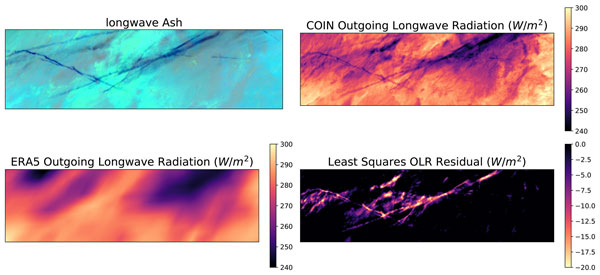
Airplane condensation trails trap heat, but their full warming effect is hard to measure because they blend into natural clouds. Using satellite observations, weather data, flight paths, and a causal inference framework, we isolated this effect without simulations or contrail masks. We found contrails trap 46.9 gigajoules of heat per kilometer flown over the Americas. This provides a crucially missing observation-based estimate of a major portion of aviation’s environmental impact.
Aaron Sarna, Vincent Meijer, Rémi Chevallier, Allie Duncan, Kyle McConnaughay, Scott Geraedts, and Kevin McCloskey
Atmos. Meas. Tech., 18, 3495–3532, https://doi.org/10.5194/amt-18-3495-2025, https://doi.org/10.5194/amt-18-3495-2025, 2025
Short summary
Short summary
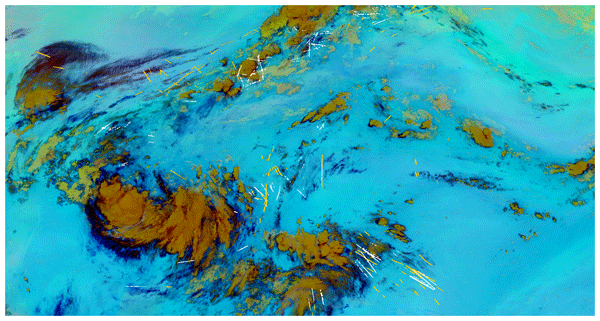
Contrails, the clouds formed by aircraft, are have a substantial climate impact. Determining which flight formed each contrail is a critical step to decreasing this impact. We introduce a dataset of synthetic contrail observations with known flight attributions that can be used to develop and assess geostationary-satellite-based contrail-to-flight attribution systems. We additionally introduce a new attribution algorithm and show that it outperforms previous methods.
Thymen Woldhuis, Zebediah Engberg, Susanne Rohs, and Vincent Meijer
EGUsphere, https://doi.org/10.5194/egusphere-2026-1171, https://doi.org/10.5194/egusphere-2026-1171, 2026
Short summary
Short summary
We introduce an algorithm that can find individual aircraft in high-resolution (10–30 m) satellite imagery to see whether they form contrails. We looked specifically for IAGOS aircraft which measure humidity: a key variable in predicting contrail formation and evolution. The final dataset consists of 543 IAGOS flights for which we know whether contrails form or not. We find excellent (98.3 %) agreement between these observations and predictions by a thermodynamic model of contrail formation.
Tharun Sankar, Thomas Dean, Tristan Abbott, Jill Blickstein, Alejandra Martín Frías, Mark Galyen, Rebecca Grenham, Paul Hodgson, Kevin McCloskey, Alan Pechman, Tyler Robarge, Dinesh Sanekommu, Aaron Sarna, Aaron Sonabend-W, Marc Stettler, Raimund Zopp, and Scott Geraedts
J. Env. Com. Air Transp. Sys. Discuss., https://doi.org/10.5194/jecats-2026-4, https://doi.org/10.5194/jecats-2026-4, 2026
Revised manuscript under review for JECATS
Short summary
Short summary
This randomized control trial provides evidence for the efficacy of airline-led contrail avoidance to reduce aviation's climate impact. By integrating ML forecasts into standard flight planning, dispatchers routed flights to avoid warming contrails. Satellite validation showed an 11.6 % overall reduction in contrails, increasing to 62 % for flights strictly following the optimized paths, all with no significant fuel penalty.
Aaron Sonabend-W, Scott Geraedts, Nita Goyal, Joe Yue-Hei Ng, Christopher Van Arsdale, and Kevin McCloskey
Atmos. Meas. Tech., 19, 1951–1972, https://doi.org/10.5194/amt-19-1951-2026, https://doi.org/10.5194/amt-19-1951-2026, 2026
Short summary
Short summary
Airplane condensation trails trap heat, but their full warming effect is hard to measure because they blend into natural clouds. Using satellite observations, weather data, flight paths, and a causal inference framework, we isolated this effect without simulations or contrail masks. We found contrails trap 46.9 gigajoules of heat per kilometer flown over the Americas. This provides a crucially missing observation-based estimate of a major portion of aviation’s environmental impact.
Joel Ponsonby, Roger Teoh, Bernd Kärcher, and Marc E. J. Stettler
Atmos. Chem. Phys., 25, 18617–18637, https://doi.org/10.5194/acp-25-18617-2025, https://doi.org/10.5194/acp-25-18617-2025, 2025
Short summary
Short summary
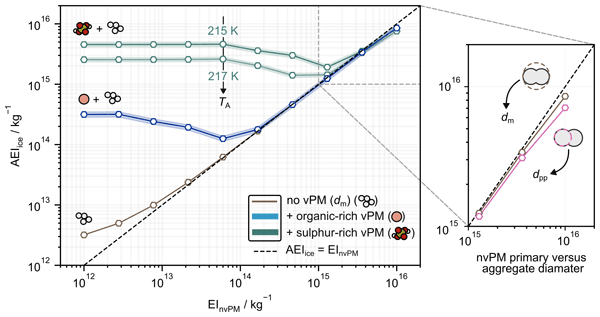
Aerosol emissions from aircraft engines contribute to the formation of contrails, which have a climate impact comparable to that of aviation’s CO2 emissions. We show that emissions of volatile particulate matter – from fuel sulphur, unburned fuel, and lubrication oil – can increase the number of ice particles formed within a contrail and therefore have an important role in the climate impacts of aviation. This has implications for emission regulation and climate mitigation strategies.
Rodrigo J. Seguel, Charlie Opazo, Yann Cohen, Owen R. Cooper, Laura Gallardo, Björn-Martin Sinnhuber, Florian Obersteiner, Andreas Zahn, Peter Hoor, Susanne Rohs, and Andreas Marsing
Atmos. Chem. Phys., 25, 8553–8573, https://doi.org/10.5194/acp-25-8553-2025, https://doi.org/10.5194/acp-25-8553-2025, 2025
Short summary
Short summary
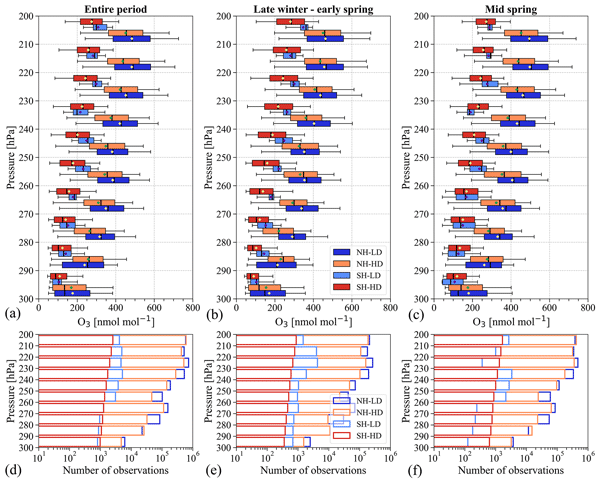
We explored ozone differences between the Northern Hemisphere and Southern Hemispheres in the upper troposphere–lower stratosphere. We found lower ozone (with stratospheric origin) in the Southern Hemisphere, especially during years of severe ozone depletion. Sudden stratospheric warming events increased the ozone in each hemisphere, highlighting the relationship between stratospheric processes and ozone in the upper troposphere, where ozone is an important greenhouse gas.
Aaron Sarna, Vincent Meijer, Rémi Chevallier, Allie Duncan, Kyle McConnaughay, Scott Geraedts, and Kevin McCloskey
Atmos. Meas. Tech., 18, 3495–3532, https://doi.org/10.5194/amt-18-3495-2025, https://doi.org/10.5194/amt-18-3495-2025, 2025
Short summary
Short summary
Contrails, the clouds formed by aircraft, are have a substantial climate impact. Determining which flight formed each contrail is a critical step to decreasing this impact. We introduce a dataset of synthetic contrail observations with known flight attributions that can be used to develop and assess geostationary-satellite-based contrail-to-flight attribution systems. We additionally introduce a new attribution algorithm and show that it outperforms previous methods.
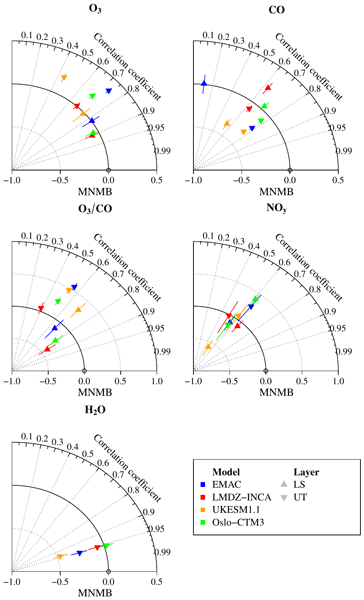
Yann Cohen, Didier Hauglustaine, Nicolas Bellouin, Marianne Tronstad Lund, Sigrun Matthes, Agnieszka Skowron, Robin Thor, Ulrich Bundke, Andreas Petzold, Susanne Rohs, Valérie Thouret, Andreas Zahn, and Helmut Ziereis
Atmos. Chem. Phys., 25, 5793–5836, https://doi.org/10.5194/acp-25-5793-2025, https://doi.org/10.5194/acp-25-5793-2025, 2025
Short summary
Short summary
The chemical composition of the atmosphere near the tropopause is a key parameter for evaluating the climate impact of subsonic aviation pollutants. This study uses in situ data collected aboard passenger aircraft to assess the ability of four chemistry–climate models to reproduce (bi-)decadal climatologies of ozone, carbon monoxide, water vapour, and reactive nitrogen in this region. The models reproduce the very distinct ozone seasonality in the upper troposphere and in the lower stratosphere well.
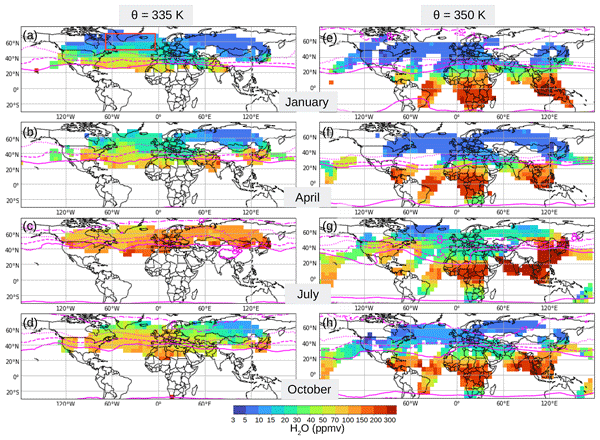
Patrick Konjari, Christian Rolf, Michaela I. Hegglin, Susanne Rohs, Yun Li, Andreas Zahn, Harald Bönisch, Philippe Nedelec, Martina Krämer, and Andreas Petzold
Atmos. Chem. Phys., 25, 4269–4289, https://doi.org/10.5194/acp-25-4269-2025, https://doi.org/10.5194/acp-25-4269-2025, 2025
Short summary
Short summary
This study introduces a new method to derive adjusted water vapor (H2O) climatologies for the upper tropopshere and lower statosphere (UT/LS) using data from 60 000 flights under the IAGOS program. Biases in the IAGOS water vapour dataset are adjusted, based on the more accurate IAGOS-CARIBIC data. The resulting highly resolved H2O climatologies will contribute to a better understanding of the H2O variability in the UT/LS and its connection to various transport and mixing processes.
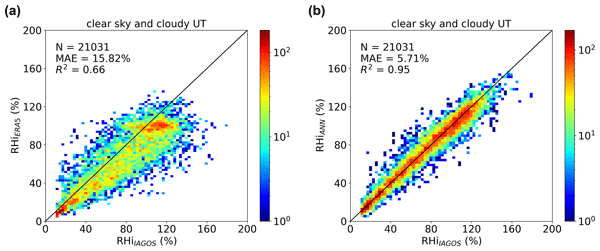
Ziming Wang, Luca Bugliaro, Klaus Gierens, Michaela I. Hegglin, Susanne Rohs, Andreas Petzold, Stefan Kaufmann, and Christiane Voigt
Atmos. Chem. Phys., 25, 2845–2861, https://doi.org/10.5194/acp-25-2845-2025, https://doi.org/10.5194/acp-25-2845-2025, 2025
Short summary
Short summary
Upper-tropospheric relative humidity bias in the ERA5 weather model is corrected by 10 % by an artificial neural network using aircraft in-service humidity data and thermodynamic and dynamical variables. The improved skills of the weather model will advance cirrus research, weather forecasts, and measures for contrail reduction.
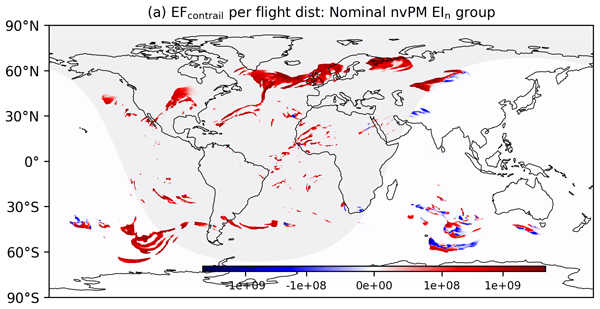
Zebediah Engberg, Roger Teoh, Tristan Abbott, Thomas Dean, Marc E. J. Stettler, and Marc L. Shapiro
Geosci. Model Dev., 18, 253–286, https://doi.org/10.5194/gmd-18-253-2025, https://doi.org/10.5194/gmd-18-253-2025, 2025
Short summary
Short summary
Contrails forming in some atmospheric conditions may persist and become strongly warming cirrus, while in other conditions may be neutral or cooling. We develop a contrail forecast model to predict contrail climate forcing for any arbitrary point in space and time and explore integration into flight planning and air traffic management. This approach enables contrail interventions to target high-probability high-climate-impact regions and reduce unintended consequences of contrail management.
Kevin Wolf, Nicolas Bellouin, Olivier Boucher, Susanne Rohs, and Yun Li
Atmos. Chem. Phys., 25, 157–181, https://doi.org/10.5194/acp-25-157-2025, https://doi.org/10.5194/acp-25-157-2025, 2025
Short summary
Short summary
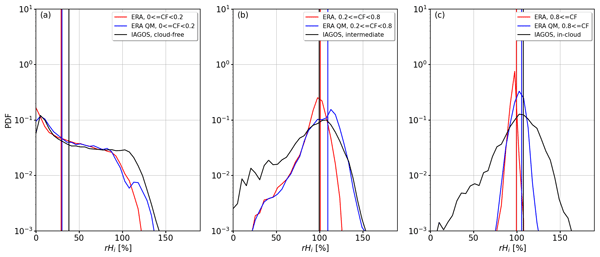
ERA5 atmospheric reanalysis and airborne in situ observations from IAGOS are compared in terms of the representation of the contrail formation potential and the presence of supersaturation. Differences are traced back to biases in ERA5 relative humidity fields. Those biases are addressed by applying a quantile mapping technique that significantly improved contrail estimation based on post-processed ERA5 data.
Jade Low, Roger Teoh, Joel Ponsonby, Edward Gryspeerdt, Marc Shapiro, and Marc E. J. Stettler
Atmos. Meas. Tech., 18, 37–56, https://doi.org/10.5194/amt-18-37-2025, https://doi.org/10.5194/amt-18-37-2025, 2025
Short summary
Short summary
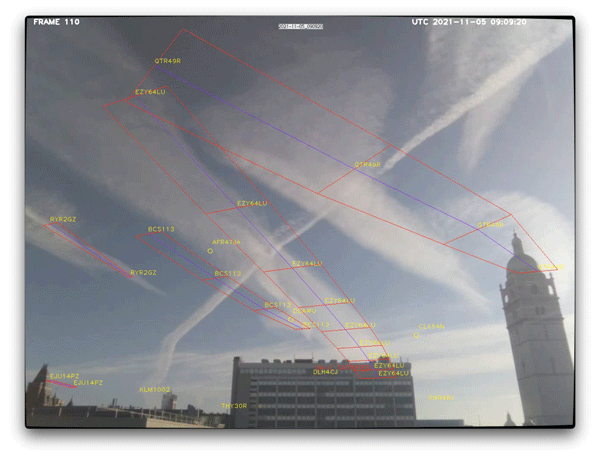
The radiative forcing due to contrails is of the same order of magnitude as aviation CO2 emissions but has a higher uncertainty. Observations are vital to improve our understanding of the contrail lifecycle, improve models, and measure the effect of mitigation action. Here, we use ground-based cameras combined with flight telemetry to track visible contrails and measure their lifetime and width. We evaluate model predictions and demonstrate the capability of this approach.

Audran Borella, Olivier Boucher, Keith P. Shine, Marc Stettler, Katsumasa Tanaka, Roger Teoh, and Nicolas Bellouin
Atmos. Chem. Phys., 24, 9401–9417, https://doi.org/10.5194/acp-24-9401-2024, https://doi.org/10.5194/acp-24-9401-2024, 2024
Short summary
Short summary
This work studies how to compare the climate impact of the CO2 emitted and contrails formed by a flight. This is applied to contrail avoidance strategies that would decrease climate impact of flights by changing the trajectory of aircraft to avoid persistent contrail formation, at the risk of increasing CO2 emissions. We find that different comparison methods lead to different quantification of the total climate impact of a flight but lead to similar decisions of whether to reroute an aircraft.
Sina Hofer, Klaus Gierens, and Susanne Rohs
Atmos. Chem. Phys., 24, 7911–7925, https://doi.org/10.5194/acp-24-7911-2024, https://doi.org/10.5194/acp-24-7911-2024, 2024
Short summary
Short summary
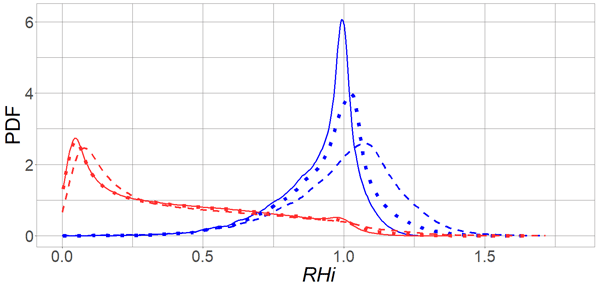
We try to improve the forecast of ice supersaturation (ISS) and potential persistent contrails using data on dynamical quantities in addition to temperature and relative humidity in a modern kind of regression model. Although the results are improved, they are not good enough for flight routing. The origin of the problem is the strong overlap of probability densities conditioned on cases with and without ice-supersaturated regions (ISSRs) in the important range of 70–100 %.
Roger Teoh, Zebediah Engberg, Ulrich Schumann, Christiane Voigt, Marc Shapiro, Susanne Rohs, and Marc E. J. Stettler
Atmos. Chem. Phys., 24, 6071–6093, https://doi.org/10.5194/acp-24-6071-2024, https://doi.org/10.5194/acp-24-6071-2024, 2024
Short summary
Short summary
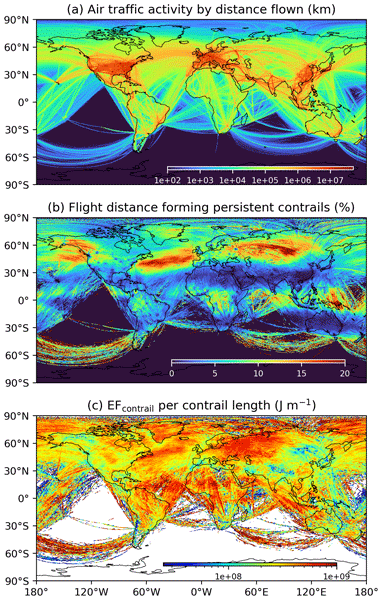
The radiative forcing (RF) due to aviation contrails is comparable to that caused by CO2. We estimate that global contrail net RF in 2019 was 62.1 mW m−2. This is ~1/2 the previous best estimate for 2018. Contrail RF varies regionally due to differences in conditions required for persistent contrails. COVID-19 reduced contrail RF by 54% in 2020 relative to 2019. Globally, 2 % of all flights account for 80 % of the annual contrail energy forcing, suggesting a opportunity to mitigate contrail RF.
Sidiki Sanogo, Olivier Boucher, Nicolas Bellouin, Audran Borella, Kevin Wolf, and Susanne Rohs
Atmos. Chem. Phys., 24, 5495–5511, https://doi.org/10.5194/acp-24-5495-2024, https://doi.org/10.5194/acp-24-5495-2024, 2024
Short summary
Short summary
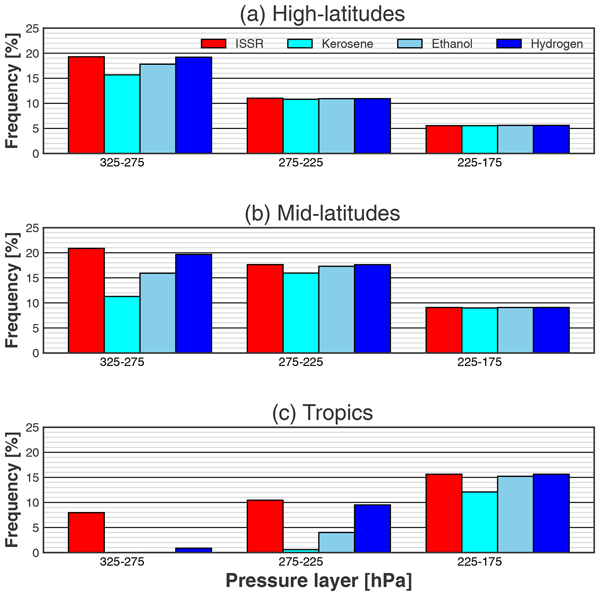
Relative humidity relative to ice (RHi) is a key variable in the formation of cirrus clouds and contrails. This study shows that the properties of the probability density function of RHi differ between the tropics and higher latitudes. In line with RHi and temperature variability, aircraft are likely to produce more contrails with bioethanol and liquid hydrogen as fuel. The impact of this fuel change decreases with decreasing pressure levels but increases from high latitudes to the tropics.
Roger Teoh, Zebediah Engberg, Marc Shapiro, Lynnette Dray, and Marc E. J. Stettler
Atmos. Chem. Phys., 24, 725–744, https://doi.org/10.5194/acp-24-725-2024, https://doi.org/10.5194/acp-24-725-2024, 2024
Short summary
Short summary
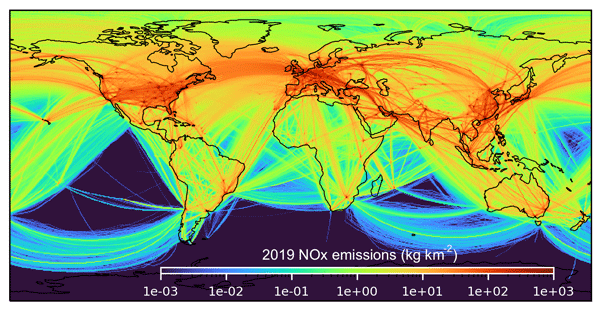
Emissions from aircraft contribute to climate change and degrade air quality. We describe an up-to-date 4D emissions inventory of global aviation from 2019 to 2021 based on actual flown trajectories. In 2019, 40.2 million flights collectively travelled 61 billion kilometres using 283 Tg of fuel. Long-haul flights were responsible for 43 % of CO2. The emissions inventory is made available for use in future studies to evaluate the negative externalities arising from global aviation.
Yann Cohen, Didier Hauglustaine, Bastien Sauvage, Susanne Rohs, Patrick Konjari, Ulrich Bundke, Andreas Petzold, Valérie Thouret, Andreas Zahn, and Helmut Ziereis
Atmos. Chem. Phys., 23, 14973–15009, https://doi.org/10.5194/acp-23-14973-2023, https://doi.org/10.5194/acp-23-14973-2023, 2023
Short summary
Short summary
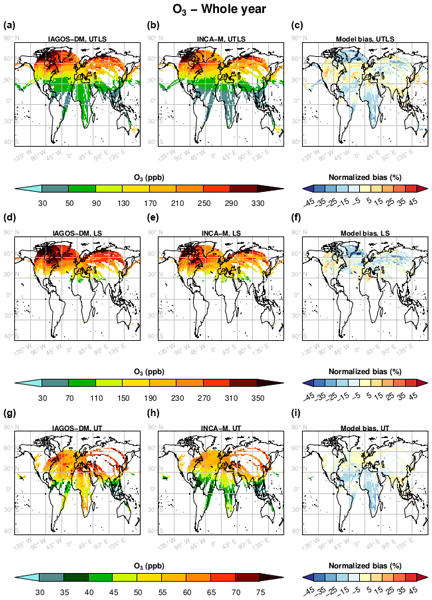
The upper troposphere–lower stratosphere (UTLS) is a key region regarding the lower atmospheric composition. This study consists of a comprehensive evaluation of an up-to-date chemistry–climate model in this layer, using regular in situ measurements based on passenger aircraft. For this purpose, a specific software (Interpol-IAGOS) has been updated and made publicly available. The model reproduces the carbon monoxide peaks due to biomass burning over the continental tropics particularly well.
Yun Li, Christoph Mahnke, Susanne Rohs, Ulrich Bundke, Nicole Spelten, Georgios Dekoutsidis, Silke Groß, Christiane Voigt, Ulrich Schumann, Andreas Petzold, and Martina Krämer
Atmos. Chem. Phys., 23, 2251–2271, https://doi.org/10.5194/acp-23-2251-2023, https://doi.org/10.5194/acp-23-2251-2023, 2023
Short summary
Short summary
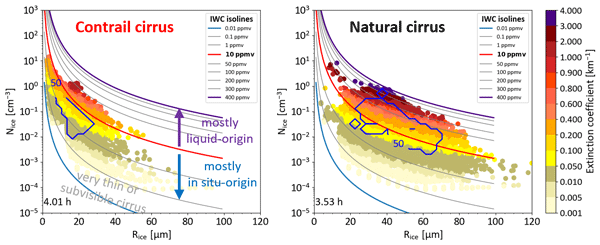
The radiative effect of aviation-induced cirrus is closely related to ambient conditions and its microphysical properties. Our study investigated the occurrence of contrail and natural cirrus measured above central Europe in spring 2014. It finds that contrail cirrus appears frequently in the pressure range 200 to 245 hPa and occurs more often in slightly ice-subsaturated environments than expected. Avoiding slightly ice-subsaturated regions by aviation might help mitigate contrail cirrus.
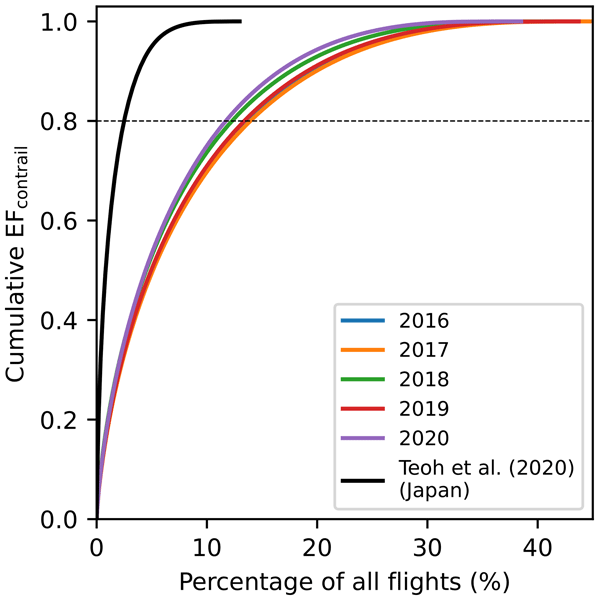
Roger Teoh, Ulrich Schumann, Edward Gryspeerdt, Marc Shapiro, Jarlath Molloy, George Koudis, Christiane Voigt, and Marc E. J. Stettler
Atmos. Chem. Phys., 22, 10919–10935, https://doi.org/10.5194/acp-22-10919-2022, https://doi.org/10.5194/acp-22-10919-2022, 2022
Short summary
Short summary
Aircraft condensation trails (contrails) contribute to over half of the climate forcing attributable to aviation. This study uses historical air traffic and weather data to simulate contrails in the North Atlantic over 5 years, from 2016 to 2021. We found large intra- and inter-year variability in contrail radiative forcing and observed a 66 % reduction due to COVID-19. Most warming contrails predominantly result from night-time flights in winter.

Klaus Gierens, Lena Wilhelm, Sina Hofer, and Susanne Rohs
Atmos. Chem. Phys., 22, 7699–7712, https://doi.org/10.5194/acp-22-7699-2022, https://doi.org/10.5194/acp-22-7699-2022, 2022
Short summary
Short summary
We are interested in the prediction of condensation trails, in particular strong ones. For this we need a good forecast of temperature and humidity in the levels where aircraft cruise. Unfortunately, the humidity forecast is quite difficult for these levels, in particular the ice supersaturation, which is needed for long-lasting contrails. We are thus seeking proxy variables that help distinguish situations where strong contrails can form, for instance the lapse rate.
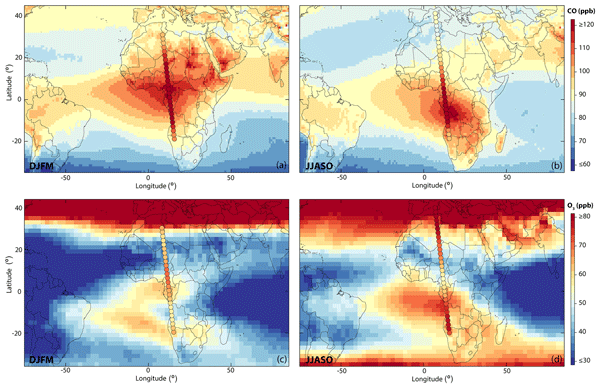
Victor Lannuque, Bastien Sauvage, Brice Barret, Hannah Clark, Gilles Athier, Damien Boulanger, Jean-Pierre Cammas, Jean-Marc Cousin, Alain Fontaine, Eric Le Flochmoën, Philippe Nédélec, Hervé Petetin, Isabelle Pfaffenzeller, Susanne Rohs, Herman G. J. Smit, Pawel Wolff, and Valérie Thouret
Atmos. Chem. Phys., 21, 14535–14555, https://doi.org/10.5194/acp-21-14535-2021, https://doi.org/10.5194/acp-21-14535-2021, 2021
Short summary
Short summary
The African intertropical troposphere is one of the world areas where the increase in ozone mixing ratio has been most pronounced since 1980 and where high carbon monoxide mixing ratios are found in altitude. In this article, IAGOS aircraft measurements, IASI satellite instrument observations, and SOFT-IO model products are used to explore the seasonal distribution variations and the origin of ozone and carbon monoxide over the African upper troposphere.
Cited articles
Agarwal, A., Meijer, V. R., Eastham, S. D., Speth, R. L., and Barrett, S. R.: Reanalysis-driven simulations may overestimate persistent contrail formation by 100 %–250 %, Environ. Res. Lett., 17, 014045, https://doi.org/10.1088/1748-9326/ac38d9, 2022. a, b
Akhtar Martínez, C., Eastham, S. D., and Jarrett, J. P.: Zero-dimensional contrail models could underpredict lifetime optical depth, Atmos. Chem. Phys., 25, 12875–12891, https://doi.org/10.5194/acp-25-12875-2025, 2025. a, b
Appleman, H. S.: The Formation of Exhaust Condensation Trails by Jet Aircraft, B. Am. Meteorol. Soc., 34, 14–20, 1953. a
Avila, D., Sherry, L., and Thompson, T.: Reducing global warming by airline contrail avoidance: A case study of annual benefits for the contiguous United States, Transportation Research Interdisciplinary Perspectives, 2, 100033, https://doi.org/10.1016/j.trip.2019.100033, 2019. a
Boulanger, D., Blot, R., Bundke, U., Gerbig, C., Hermann, M., Nédélec, P., Rohs, S., and Ziereis, H.: IAGOS final quality controlled Observational Data L2–Time series, Aeris [data set], https://www.iagos.org/ (last access: 30 January 2026), 2018. a
Chevallier, R., Shapiro, M., Engberg, Z., Soler, M., and Delahaye, D.: Linear Contrails Detection, Tracking and Matching with Aircraft Using Geostationary Satellite and Air Traffic Data, Aerospace, 10, https://doi.org/10.3390/aerospace10070578, 2023. a
Driver, O. G. A., Stettler, M. E. J., and Gryspeerdt, E.: Factors limiting contrail detection in satellite imagery, Atmos. Meas. Tech., 18, 1115–1134, https://doi.org/10.5194/amt-18-1115-2025, 2025. a, b
El Kassar, J., Carbajal Henken, C., Calbet, X., Rípodas, P., Preusker, R., and Fischer, J.: Optimal estimation retrieval framework for daytime clear-sky total column water vapour from MTG-FCI near-infrared measurements, Atmos. Meas. Tech., 19, 135–155, https://doi.org/10.5194/amt-19-135-2026, 2026. a
Euchenhofer, M. V., Prashanth, P., Parke, S. A., Eastham, S. D., and Waitz, I. A.: Contrail Observation Limitations Using Geostationary Satellites, Geophys. Res. Lett., 52, e2025GL118386, https://doi.org/10.1029/2025GL118386, 2025. a, b
Frias, A. M., Shapiro, M., Engberg, Z., Zopp, R., Soler, M., and Stettler, M. E. J.: Feasibility of contrail avoidance in a commercial flight planning system: an operational analysis, Environmental Research: Infrastructure and Sustainability, 4, 015013, https://doi.org/10.1088/2634-4505/ad310c, 2024. a
Fritz, T. M., Eastham, S. D., Speth, R. L., and Barrett, S. R. H.: The role of plume-scale processes in long-term impacts of aircraft emissions, Atmos. Chem. Phys., 20, 5697–5727, https://doi.org/10.5194/acp-20-5697-2020, 2020. a
Geraedts, S., Brand, E., Dean, T. R., Eastham, S., Elkin, C., Engberg, Z., Hager, U., Langmore, I., McCloskey, K., Ng, J. Y.-H., Platt, J. C., Sankar, T., Sarna, A., Shapiro M., and Goyal, N.: A scalable system to measure contrail formation on a per-flight basis, Environmental Research Communications, 6, 015008, https://doi.org/10.1088/2515-7620/ad11ab, 2024. a
Geraedts, S., Sarna, A., Teoh, R., Rohs, S., and McCloskey, K.: Supplemental data for ”Improving reanalysis weather for contrail validation by incorporating satellite observations”, Zenodo [data set], https://doi.org/10.5281/zenodo.19440374, 2026. a
Gierens, K., Schumann, U., Helten, M., Smit, H., and Marenco, A.: A distribution law for relative humidity in the upper troposphere and lower stratosphere derived from three years of MOZAIC measurements, Ann. Geophys., 17, 1218–1226, https://doi.org/10.1007/s00585-999-1218-7, 1999. a
Gierens, K., Matthes, S., and Rohs, S.: How Well Can Persistent Contrails Be Predicted?, Aerospace, 7, https://doi.org/10.3390/aerospace7120169, 2020. a, b
Goodman, S. J., Schmit, T. J., Daniels, J., and Redmon, R. J.: The GOES-R series: a new generation of geostationary environmental satellites, Elsevier, ISBN 9780128143278, 2019. a
Hanst, M., Köhler, C. G., Seifert, A., and Schlemmer, L.: Predicting ice supersaturation for contrail avoidance: ensemble forecasting using ICON with two-moment ice microphysics, Atmos. Chem. Phys., 25, 17253–17274, https://doi.org/10.5194/acp-25-17253-2025, 2025. a, b
Hersbach, H., Bell, B., Berrisford, P., Hirahara, S., Horányi, A., Muñoz-Sabater, J., Nicolas, J., Peubey, C., Radu, R., Schepers, D., Simmons, A., Soci, C., Abdalla, S., Abellan, X., Balsamo, G., Bechtold, P., Biavati, G., Bidlot, J., Bonavita, M., Chiara, G., Dahlgren, P., Dee, D., Diamantakis, M., Dragani, R., Flemming, J., Forbes, R., Fuentes, M., Geer, A., Haimberger, L., Healy, S., Hogan, R. J., Hólm, E., Janisková, M., Keeley, S., Laloyaux, P., Lopez, P., Lupu, C., Radnoti, G., Rosnay, P., Rozum, I., Vamborg, F., Villaume, S., and Thépaut, J.-N.: The ERA5 global reanalysis, Q. J. Roy. Meteor. Soc., 146, 1999–2049, 2020. a
Jarry, G., Dalmau, R., Very, P., Ballerini, F., and Bocu, S.-D.: GVCCS: a dataset for contrail identification and tracking on visible whole sky camera sequences, Earth Syst. Sci. Data, 18, 1037–1059, https://doi.org/10.5194/essd-18-1037-2026, 2026. a, b
Jeßberger, P., Voigt, C., Schumann, U., Sölch, I., Schlager, H., Kaufmann, S., Petzold, A., Schäuble, D., and Gayet, J.-F.: Aircraft type influence on contrail properties, Atmos. Chem. Phys., 13, 11965–11984, https://doi.org/10.5194/acp-13-11965-2013, 2013. a
Kärcher, B.: Formation and radiative forcing of contrail cirrus, Nat. Commun., 9, 1824, https://doi.org/10.1038/s41467-018-04068-0, 2018. a
Kärcher, B. and Corcos, M.: On the Lifetimes of Persistent Contrails and Contrail Cirrus, J. Geophys. Res.-Atmos., 130, e2025JD044488, https://doi.org/10.1029/2025JD044488, 2025. a
Kurth, T., Subramanian, S., Harrington, P., Pathak, J., Mardani, M., Hall, D., Miele, A., Kashinath, K., and Anandkumar, A.: FourCastNet: Accelerating Global High-Resolution Weather Forecasting Using Adaptive Fourier Neural Operators, in: Proceedings of the Platform for Advanced Scientific Computing Conference, PASC '23, Association for Computing Machinery, New York, NY, USA, ISBN 9798400701900, https://doi.org/10.1145/3592979.3593412, 2023. a
Lee, D. S., Fahey, D., Skowron, A., Allen, M., Burkhardt, U., Chen, Q., Doherty, S., Freeman, S., Forster, P., Fuglestvedt, J., Gettelman, J. A., De León, R. R., Lim, L. L., Lund, M. T., Millar, R. J., Owen, B., Penner, J. E., Pitari, G., Prather, M. J., Sausen, R., and Wilcox, L. J.: The contribution of global aviation to anthropogenic climate forcing for 2000 to 2018, Atmos. Environ., 244, 117834, https://doi.org/10.1016/j.atmosenv.2020.117834, 2021. a
Low, J., Teoh, R., Ponsonby, J., Gryspeerdt, E., Shapiro, M., and Stettler, M. E. J.: Ground-based contrail observations: comparisons with reanalysis weather data and contrail model simulations, Atmos. Meas. Tech., 18, 37–56, https://doi.org/10.5194/amt-18-37-2025, 2025. a
Ng, J. Y.-H., McCloskey, K., Cui, J., Meijer, V. R., Brand, E., Sarna, A., Goyal, N., Van Arsdale, C., and Geraedts, S.: Contrail Detection on GOES-16 ABI With the OpenContrails Dataset, IEEE T. Geosci. Remote, https://doi.org/10.1109/TGRS.2023.3345226, 2023. a, b
Platt, J. C., Shapiro, M. L., Engberg, Z., McCloskey, K., Geraedts, S., Sankar, T., Stettler, M. E., Teoh, R., Schumann, U., Rohs, S., Brand, E., and Van Arsdale, C.: The effect of uncertainty in humidity and model parameters on the prediction of contrail energy forcing, Environmental Research Communications, 6, 095015, https://doi.org/10.1088/2515-7620/ad6ee5, 2024. a
Poll, D. and Schumann, U.: An estimation method for the fuel burn and other performance characteristics of civil transport aircraft in the cruise. Part 1 fundamental quantities and governing relations for a general atmosphere, Aeronaut. J., 125, 257–295, https://doi.org/10.1017/aer.2020.62, 2021. a
Rosenow, J. and Luo, M.: A Contrail Life Cycle Model with Interaction of Overlapping Contrails, Aerospace, 13, https://doi.org/10.3390/aerospace13020164, 2026. a, b
Sarna, A., Meijer, V., Chevallier, R., Duncan, A., McConnaughay, K., Geraedts, S., and McCloskey, K.: Benchmarking and improving algorithms for attributing satellite-observed contrails to flights, Atmos. Meas. Tech., 18, 3495–3532, https://doi.org/10.5194/amt-18-3495-2025, 2025. a, b, c, d, e, f, g, h, i
Schmidt, E.: Die Entstehung von Eisnebel aus den Auspuffgasen von Flugmotoren, Eintrag von Ulrich Schumann, zur Sicherstellung des Zugangs zu diesem wissenschaftshistorisch wichtigen Dokument; mit Zustimmung des Rechteinhabers (Nachfolger des Oldenbourg Verlags), https://elib.dlr.de/107948/ (last access: January 2026), 1941. a
Schumann, U.: On conditions for contrail formation from aircraft exhausts, Meteorol. Z., 5, 4–23, 1996. a
Schumann, U.: A contrail cirrus prediction model, Geosci. Model Dev., 5, 543–580, https://doi.org/10.5194/gmd-5-543-2012, 2012. a, b, c
Schumann, U., Graf, K., and Mannstein, H.: Potential to reduce the climate impact of aviation by flight level changes, in: 3rd AIAA Atmospheric Space Environments Conference, https://doi.org/10.2514/6.2011-3376, 2011. a
Shapiro, M., Engberg, Z., Teoh, R., Stettler, M., Dean, T., and Abbott, T.: pycontrails: Python library for modeling aviation climate impacts, Zenodo [code], https://doi.org/10.5281/zenodo.13357046, 2024. a
Sonabend-W, A., Geraedts, S., Goyal, N., Ng, J. Y.-H., Van Arsdale, C., and McCloskey, K.: Observing long-lived longwave contrail forcing, Atmos. Meas. Tech., 19, 1951–1972, https://doi.org/10.5194/amt-19-1951-2026, 2026. a
Teoh, R., Schumann, U., Gryspeerdt, E., Shapiro, M., Molloy, J., Koudis, G., Voigt, C., and Stettler, M. E. J.: Aviation contrail climate effects in the North Atlantic from 2016 to 2021, Atmos. Chem. Phys., 22, 10919–10935, https://doi.org/10.5194/acp-22-10919-2022, 2022. a
Teoh, R., Engberg, Z., Schumann, U., Voigt, C., Shapiro, M., Rohs, S., and Stettler, M. E. J.: Global aviation contrail climate effects from 2019 to 2021, Atmos. Chem. Phys., 24, 6071–6093, https://doi.org/10.5194/acp-24-6071-2024, 2024. a
Thompson, G., Scholzen, C., O'Donoghue, S., Haughton, M., Jones, R. L., Durant, A., and Farrington, C.: On the fidelity of high-resolution numerical weather forecasts of contrail-favorable conditions, Atmos. Res., 311, 107663, https://doi.org/10.1016/j.atmosres.2024.107663, 2024. a
Short summary
It can be difficult to know if a given aircraft made a contrail. Existing methods that can be applied to any aircraft either use numerical weather data or satellite observations. In this work we create a new method by combining weather data and observations together. By comparison to in-situ measurements we show that the new method is superior to previous methods.
It can be difficult to know if a given aircraft made a contrail. Existing methods that can be...


