 | 22 Jan 2026
Editorial: A new sustainable aviation open-access journal
Simon Blakey
Florian Linke
Sigrun Matthes
Jan Middel
Radu Mirea
Ayce Celikel
David Raper
Feijia Yin
- Article
(444 KB) - Full-text XML
- BibTeX
- EndNote


The Journal of Environmentally Compatible Air Transport System (JECATS) is a not-for-profit international scientific journal dedicated to the publication and public discussion of aspects of the air transport system with a focus on the environmental implications. JECATS publishes original research and review articles that especially, but not solely, combine areas of aerospace engineering, fuels, environmental analysis, climate change, economics, aviation climate mitigation, circularity and policy analysis. It includes aviation transport-related aspects and environmental effects from local to global scales. Research articles and review articles are considered for peer-reviewed publication. These are complemented by invited perspective articles and communications contributions. JECATS publishes special issues of the conferences of the non-profit international association ECATS AISBL (Association internationale sans but lucratif, http://www.ecats-network.eu, last access: 8 January 2026).
A two-stage publication process involving the scientific discussion forum JECATS Discussions (JECATSD) is considered, in order to
-
foster and provide a lasting record of scientific discussion;
-
maximize the effectiveness and transparency of scientific quality assurance;
-
enable rapid posting of new scientific results;
-
make scientific publications freely accessible.
In the first stage, papers that pass a rapid access peer review by the topical editor are immediately posted in JECATSD (Journal of ECATS Discussion). They are then subject to interactive public discussion, during which the referees' comments (anonymous or attributed), additional comments by other members of the scientific community (attributed), and the authors' replies are also posted. In the second stage, the peer-review process is completed and, if accepted, the final revised papers are published in JECATS. To ensure publication precedence for authors, and to provide a lasting record of scientific discussion, JECATSD and JECATS are both ISSN-registered, permanently archived, and fully citable.
JECATS also offers an efficient way of publishing special issues, in which the individual papers are published following the default interactive public discussion as ordinary submissions but are linked electronically. Special issues involving guest editors can be proposed to the executive editors and will focus on specific topics to highlight associated work.
The journal is hosted by the non-profit organisation ECATS that started as an EU-funded network-of-excellence (NoE – January 2005 to January 2012), comprising leading aeronautical European research establishments and universities. The aim was to provide a basis for a durable and long-lasting means of cooperation in the field of aeronautics and the environment. The overall goals of the NoE ECATS were to create a European Virtual Institute for research on environmentally compatible air transport, to develop and maintain durable means for cooperation and communication within Europe and to strengthen Europe's excellence and its influential role in the international community. As a result, the ECATS non-profit association was founded in 2010 with rotating chairs and vice-chairs. ECATS is initiating cooperations that lead to several EU-projects, organises the ECATS-conferences, workshops and PhD-schools. The work is organised in working groups that overlap and form the research topics of JECATS.
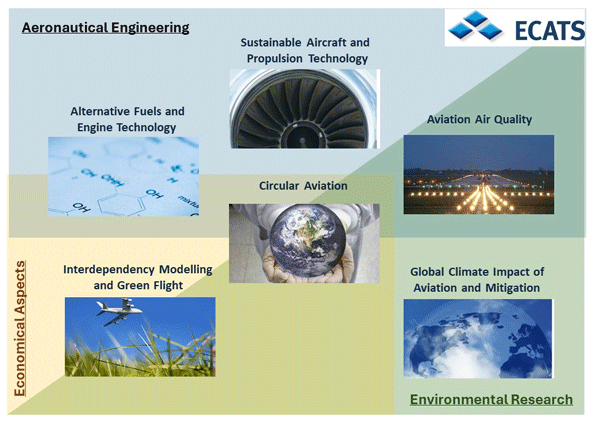
The journal's topics are resembling the scope and working areas of ECATS that combine aeronautical engineering, environmental and climate science and economical aspects. The interdisciplinarity is an important aspect and necessary for the needs of sustainable aviation.

Figure 1Overview on the Journal's subjects and ECATS working groups.
The journal addresses the following six topics that are closely linked and intentionally overlapping (Abbreviations are in brackets):
-
Alternative Fuels and Engine Technology (Fuels)
-
fuel production
-
fuel impacts on the performance of air breathing engines
-
characterisation of engine emissions
-
environmental impact of fuel from renewable sources and fuel additives
-
-
Aviation Air Quality (AAQ)
-
local and regional air quality
-
dispersion of material from aero-engines
-
sources & source apportionment
-
relevance of aerosols and gaseous species (NOx, O3, etc.) for health
-
interdependencies of environmental impacts (including noise)
-
-
Global Climate Impact of Aviation and Mitigation (Clim)
-
climate effects of CO2 and non-CO2 emissions
-
climate metrics
-
solutions for a more environmentally sustainable aviation system: operations, technology and fuels
-
science-based guidance to stakeholders and policy makers
-
-
Interdependency Modelling and Green Flight (IM/GF)
-
environmentally friendly en-route operations
-
procedures and techniques for departing and approaching an airport, ground operations
-
met-service for climate optimized flight planning
-
interdependencies between operational, economic, environmental (climate, air quality, noise) and regulatory aspects
-
-
Sustainable Aircraft and Propulsion Technology (SAPT)
-
advanced combustion technologies
-
sustainable aircraft propulsion technologies
-
aircraft engine performance and emission modelling
-
technology impacts assessments
-
-
Circular aviation (CircA)
-
aircraft design and operations across its entire life cycle
-
end-of-life practices
-
life cycle engineering assessments (life-cycle-assessment, life-cycle-costs)
-
The topics combine areas of aeronautical engineering, environmental research and economical aspects. For example, a manuscript that investigates climate optimized trajectories addresses the two topics Clim and IM/GF, whereas a climate optimized engine technology might address the topics Fuel, SAPT, and Clim.
JECATS is published by Copernicus Publications and offers an interactive, transparent public peer-review discussion process. After a rapid screening by topical editors, the manuscript is published as a preprint in a discussion forum. The discussion phase is open to the public for 8 weeks, during which the preprint can be commented on by the invited referees (minimum of two required), authors, and other interested researchers to allow for a vivid and stimulated discussion. The authors are encouraged to rapidly reply to comments from the community to facilitate the discussion. The final editorial decision will be based on the comments from the referees and the community and the authors' replies.
Table 1Editorial board of the Journal of ECATS (JECATS) at launch in alphabetical order.

ExE = Executive Editor, TE = Topical Editor, For topics abbreviation see Sect. 3.
GMD executive editors (2019) clearly described in their editorial for the journal Geoscientific Model Development the need of open-access of code and data to maintain scientific standards such as reproducibility. Hence, full access to code and input data is required to fully understand all hypothesis, implementation of mathematical modelling and allow the identification of (unintentional) bugs. They stated “In order for the reader to have some confidence that the hypotheses above hold, it is not sufficient that the source code is provided. It is also necessary to have access to all of the input data and to know all of the steps which were taken from raw data to points on graphs or numbers in tables. This also implies that all model configuration files are provided.” Here we gladly follow their requirements that are based on long-lasting experience. Hence those data and code must be made available considering institutional persistence, irrevocability, and persistent identification (DOI).
The publication process is often a complex process that requires some attention to allow for transparency and fairness. Here, we require that all authors disclose their contributions to the research presented in their manuscripts in a dedicated section and recommend the CRediT (Contributor Roles Taxonomy) framework that allows for specifying each author's contribution in terms of conceptualization, data curation, formal analysis, funding acquisition, investigation, methodology, project administration, resources, software, supervision, validation, visualization, writing – original draft, writing – review & editing.
The use of artificial intelligence (AI) in the preparation of manuscripts is becoming popular and is widely discussed in science (Khalifa and Albadawy, 2024; Goyanes et al., 2025). We recognise the large potential for scientists in enhancing the efficiency of their work from literature surveys to improving language and readability. Authors preparing a manuscript for JECATS are free to use such tools in support of their work. However, the authors must stay in control of the work with their critical thinking. This includes a careful review, evaluation, expansion, and revision of all AI generated output. The manuscript must reflect the authentic and original contribution from the authors. In parallel to the author contributions the use of AI in the manuscript preparation must be disclosed. The AI tool, its use and the examination of its output has to be described to guarantee transparency and trust in the scientific community.
The editorial board at launch consists of topical and executive editors. Topical editors volunteer to deal with the submitted manuscripts and take the decision for publication based on the reviews and open comments, whereas executive editors manage and control the journal supervision, providing consultancy to topical editors, initiating actions in case of stalled processes and deal with appeals. The editorial board consists of representatives of members of the ECATS association who are experts in their field. It is diverse, both with respect to age, gender, affiliations, and specializations and broadly cover the journal's topic. The different expertise of the editors shows a large variety of topic combinations assuring the ability to handle submissions manuscripts of interdisciplinary research (Table 1, Sect. 3).
VG: conceptualization, project administration, visualization, writing – original draft; SB: writing – review & editing; FL: writing – review & editing; SM: writing – review & editing; JM: writing – review & editing; RM: writing – review & editing; AC: writing – review & editing; DR: writing – review & editing; YF: writing – review & editing; XZ: writing – review & editing.
GMD executive editors: Editorial: The publication of geoscientific model developments v1.2, Geosci. Model Dev., 12, 2215–2225, https://doi.org/10.5194/gmd-12-2215-2019, 2019.
Goyanes, M., Lopezosa, C., and Piñeiro-Naval, V.: The use of artificial intelligence (AI) in research: a review of author guidelines in leading journals across eight social science disciplines, Scientometrics, 130, 3725–3741, https://doi.org/10.1007/s11192-025-05377-0, 2025.
Khalifa, M. and Albadawy, M.: Using artificial intelligence in academic writing and research: An essential productivity tool, Computer Methods and Programs in Biomedicine Update, 5, 100145, https://doi.org/10.1016/j.cmpbup.2024.100145, 2024.